Finding the best alaska road trip stops for families requires balancing interactive wildlife encounters and hands-on history with realistic highway pacing. When traveling with children or multi-generational groups, the most successful routes cap driving at three to four hours per day, breaking up transit with accessible trail walks, marine science centers, and living history sites across Alaska's paved highway corridors.
The Reality of Planning an Alaska Road Trip with Children
The single most common mistake families make when planning an Alaska driving route is trusting map applications for travel times. On paper, driving 150 miles along the Parks Highway or Sterling Highway looks like a standard two-and-a-half-hour trip. In reality, that drive regularly takes 3.5 to 4.5 hours between late May and September. Single-lane highways, heavy motorhome traffic, slow-moving commercial transport, and seasonal road construction pilot cars dictate your pace. When you add mandatory fuel stops and restless children, an ambitious itinerary quickly becomes an exhausting marathon.
To keep young travelers engaged and prevent meltdown-inducing travel days, adopt a strict pacing rule: plan no more than three to four hours of total drive time per day, broken into segments of 90 minutes or less. Every extended stretch behind the wheel should lead to an interactive stop where kids can move, touch, and explore rather than just stare through a car window.
Building a successful route means focusing on accessible, paved corridors—primarily the Seward Highway, Glenn Highway, and Parks Highway. These corridors connect major natural wonders with well-maintained facilities, interpretive ranger programs, and predictable service hubs. Choosing educational stops that combine tactile science, indigenous culture, and living history keeps the trip memorable for elementary students, teenagers, and grandparents alike.
Coastal Wonders: Best Alaska Road Trip Stops for Families on the Kenai Peninsula
The Kenai Peninsula offers some of the highest concentrations of accessible coastal scenery and marine education in the state. Running south from Anchorage along the Turnagain Arm and through the Kenai Mountains, this corridor features three premier stops that highlight marine life, glaciology, and coastal geography.
1. Alaska SeaLife Center (Seward)
Located at Mile 0 of the Seward Highway on the shores of Resurrection Bay, the Alaska SeaLife Center is the state's only public aquarium and dedicated marine mammal rescue facility. Unlike conventional aquariums, the center operates as an active research institution, allowing families to see how marine biologists care for injured sea otters, harbor seals, and abandoned walrus calves.
Children can spend hours exploring the indoor discovery touch tanks, feeling cold-water anemones, sea stars, and urchins under the supervision of marine educators. The two-story underwater viewing tanks provide close-up looks at diving puffins, murres, and Steller sea lions. Plan to spend two to three hours here. Because Seward is a premier hub on our Seward Highway guide, pairing the SeaLife Center with an afternoon harbor walk makes for an ideal, low-mileage family day.
2. Begich, Boggs Visitor Center and Portage Lake
Situated in Portage Valley at the southern end of Turnagain Arm, the Begich, Boggs Visitor Center is built on the terminal moraine left by Portage Glacier. Operated by the U.S. Forest Service within the Chugach National Forest, this center provides an exceptional look at glaciology, boreal forest ecology, and wildlife biology tailored for school-aged kids.
Inside, interactive exhibits allow children to touch real glacial ice, listen to simulated sounds of calving bergs, and learn how vegetation recolonizes land as glaciers retreat. Outside the facility, paved walking paths wind along Portage Lake, where floating blue icebergs frequently drift close to shore. The center is fully stroller-accessible and offers a junior ranger badge program that teaches kids how to identify regional flora and animal tracks.
3. Beluga Point and Bird Point (Turnagain Arm)
Driving along the dramatic cliffs of Turnagain Arm, Beluga Point (Mile 110.5) and Bird Point (Mile 96) serve as essential roadside pullouts that double as open-air classrooms. Beluga Point offers elevated viewing platforms equipped with mounted spotting scopes. From mid-July through August, schools of beluga whales frequently follow the incoming tide into Turnagain Arm to hunt salmon, surfacing just off the rocky shore.
High on the cliffs directly across the Seward Highway, children can regularly spot white Dall sheep grazing on alpine ledges. Further down the highway, Bird Point features paved interpretive trails, accessible restrooms, and educational panels explaining the famous Turnagain Arm bore tide—a rushing wall of water up to six feet tall created by extreme tidal swings. Both stops are paved and secure, making them among the best alaska road trip stops for families needing a fast, scenic leg-stretcher between Anchorage and the Kenai Peninsula.
Interior and Mountain Highlights: Best Alaska Road Trip Stops for Families
Heading north toward the Alaska Range, the Parks Highway connects coastal ecosystems to the rugged interior. These three locations deliver predictable wildlife viewings, working sled dog demonstrations, and pioneer aviation history without demanding strenuous backcountry navigation.
4. Alaska Wildlife Conservation Center (Portage)
Located near the junction of the Seward and Glenn Highways, the Alaska Wildlife Conservation Center spans over 200 acres of spacious natural habitats dedicated to rescuing and rehabilitating orphaned and injured Alaskan wildlife. For traveling families, this sanctuary provides guaranteed, safe, and ethical wildlife viewing that wild highways cannot guarantee.
Families can walk the 1.5-mile paved perimeter loop or drive their vehicle between habitats to observe wood bison, coastal brown bears, black bears, moose, musk oxen, and lynx. Educational staff conduct daily animal feedings and talks that explain why the center's wood bison reintroduction program is critical to restoring these prehistoric herbivores to interior Alaska. The wide, flat pathways are completely stroller-friendly, and the on-site facilities make it an effortless two-hour stop.
5. Denali National Park Sled Dog Kennels (Mile 3 Denali Park Road)
Denali is home to the only active sled dog kennel in the entire National Park Service. Located just three miles past the park entrance, these working Alaskan huskies are not show animals; they patrol over two million acres of designated wilderness during the sub-zero winter months when motorized vehicles are prohibited.
During the summer season, the park runs free daily ranger demonstrations. Children can meet the dogs in their open-air pens, learn how rangers care for canine teams in sub-zero weather, and watch the dogs pull a wheeled training rig around a gravel track. Visiting the kennels is an essential stop on a kid friendly alaska road trip, providing a vivid look into historical and modern Arctic survival without needing to venture deep into the park interior.
6. Talkeetna Riverfront Park
The historic village of Talkeetna sits at the end of a 14-mile spur road off the Parks Highway. At the end of Main Street, Talkeetna Riverfront Park overlooks the dramatic confluence of three major glacial waterways: the Susitna, Chulitna, and Talkeetna Rivers. On clear summer days, the gravel banks provide an unobstructed view of Denali and Mount Foraker rising along the northern horizon.
Talkeetna is the primary staging area for Denali climbing expeditions, making the town an exciting hub of aviation and mountaineering history. Children can skip stones along the wide gravel bars, watch bush planes take off from nearby airstrips on glacier-landing flights, and explore historic log cabins dating back to the 1916 gold and railroad construction booms. The park's flat terrain and proximity to local bakeries and restrooms make it a painless family stop.
Educational Stops in Alaska: Hands-On Science and Gold Rush History
Beyond natural scenery, Alaska's road system connects several exceptional cultural institutions. These three destinations stand out as premier educational stops in alaska, offering guided learning experiences that bring frontier history, engineering, and paleobiology to life.
7. The Musk Ox Farm (Palmer)
Situated in the fertile Matanuska Valley near Palmer, The Musk Ox Farm is a non-profit agricultural project dedicated to the gentle domestication of musk oxen—an Arctic mammal that roamed the tundra alongside woolly mammoths during the Pleistocene epoch. The farm's primary goal is the sustainable harvesting of qiviut, the ultra-fine underwool shed by the animals each spring.
Guided walking tours lead visitors along pasture fences where educators explain Arctic mammalian adaptations, prehistoric migration across the Bering Land Bridge, and how indigenous knitters transform raw qiviut into valuable garments. The tours are gentle, 45-minute walking routes suitable for young children and seniors. Because the animals remain in large grassy pens, kids get close-up views of these shaggy, horn-crowned relic species in a calm setting.
8. Independence Mine State Historical Park (Hatcher Pass)
Perched high in the alpine tundra of the Talkeetna Mountains at Hatcher Pass, Independence Mine preserves the remains of a massive hard-rock gold mining operation that employed hundreds of workers during the 1930s and early 1940s. At its peak, the mine was a self-contained community complete with bunkhouses, a mess hall, an assay office, and an extensive mill processing plant.
Families can take a self-guided walking tour along paved and gravel paths connecting the restored wooden buildings. Interpretive displays inside the Manager's House show how mining families lived in harsh sub-arctic winters, while children can examine historic machinery, narrow-gauge mine tracks, and rock crushers. The surrounding alpine valley features easy walking loops with clear views of mountain streams and frequent marmot sightings.
9. Fountainhead Antique Auto & Wedge Historical Museum (Fairbanks)
For families reaching Fairbanks at the northern terminus of the Parks Highway, the Fountainhead Antique Auto Museum delivers a surprising blend of automotive history, sub-arctic engineering, and fashion. The museum houses over 85 historically significant pre-World War II automobiles, with a special emphasis on how early pioneers modified early horseless carriages to survive frozen Alaskan terrain.
Kids can examine early steam cars, primitive snowmobiles, and track-converted Model Ts used to transport mail over snow-packed winter trails before paved roads existed. The museum includes interactive photo stations where children and parents can dress up in authentic vintage cold-weather driving coats, goggles, and hats for family photos, making it one of the most engaging indoor educational stops in the Interior.
Glacier Access Without Long Backcountry Hikes
Seeing a glacier is a bucket-list priority for most visitors, but accessing terminal ice faces often requires multi-mile backcountry treks or expensive helicopter flights. These two road-accessible glacier sites let families experience ancient ice safely with minimal hiking.
10. Matanuska Glacier State Recreation Site and Byron Glacier Trail
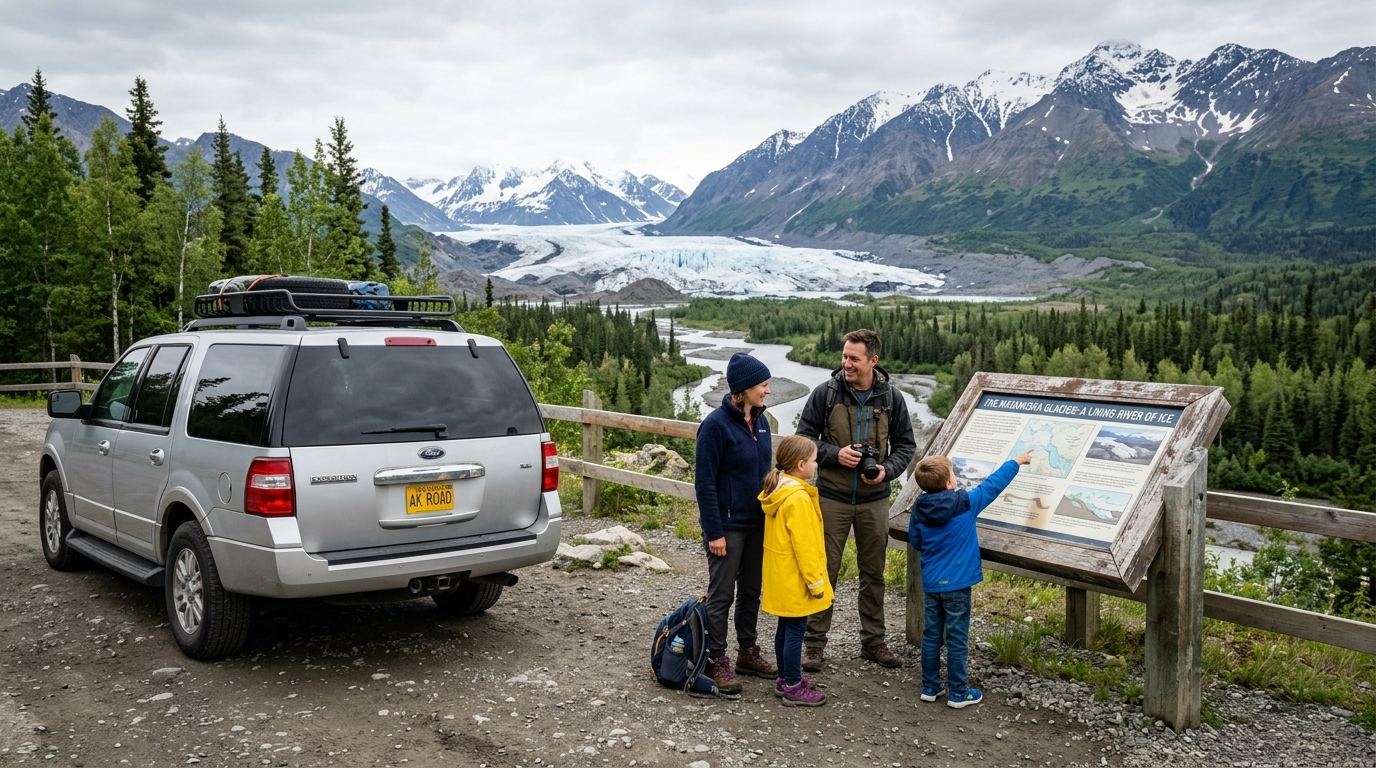
Along the Glenn Highway at Mile 101, the Matanuska Glacier State Recreation Site provides safe, elevated viewing of Alaska's largest car-accessible glacier. The state recreation site features the Edge Nature Trail, a 20-minute loop walk through spruce forest to wooden viewing decks overlooking the four-mile-wide glacier terminus. Interpretive signs explain how the glacier carved the Matanuska River Valley during past ice ages.
South of Anchorage in Portage Valley, the Byron Glacier Trail offers a flat, 1.4-mile round-trip walk along Byron Creek. The packed gravel trail is easy for toddlers and sturdy strollers, winding through alder thickets to a dramatic rocky basin where Byron Glacier hangs from surrounding mountain walls. Snowfields frequently persist near the base of the trail well into July, allowing kids to touch packed glacial snow safely without stepping onto active crevassed ice.
Essential Safety Rules for Families Near Glacial Sites
- Stay off unguided ice: rarely walk onto active glacier surfaces or approach ice caves without professional guides and safety gear. Glacial ice contains hidden crevasses, collapsing overhead arches, and fragile meltwater moulins.
- Keep away from silty riverbanks: Glacial rivers carry heavy loads of pulverized rock flour. What appears to be solid river mud is often quicksand-like glacial silt that can trap boots and destabilize underfoot.
- Dress for sudden temperature drops: Glaciers generate their own microclimates. Katabatic winds blowing off the ice field can drop air temperatures significantly within a few hundred yards of the viewing areas. often pack windproof jackets and warm hats for your kids.
Route Logistics for a Smooth Kid Friendly Alaska Road Trip
Managing day-to-day logistics along Alaska's highway network requires proactive planning. Facilities are spread across hundreds of miles, and standard road-trip habits from the lower 48 states do not directly translate to northern travel.
Bathroom and Rest-Stop Strategy
Between major towns like Anchorage, Palmer, Fairbanks, and Soldotna, formal rest stops are infrequent. Many state highway pullouts offer only basic vault toilets without running water or soap. Keep hand sanitizer, wet wipes, and a small roll of toilet paper accessible in the front seat of your vehicle. Establish a firm family rule: when you stop for fuel at a service station with clean indoor plumbing, everyone uses the restroom regardless of whether they feel the need.
Managing Cellular Dead Zones
Cell phone coverage drops out frequently along the Sterling Highway through Cooper Landing, across large sections of the Glenn Highway between Palmer and Glennallen, and on the Parks Highway between Cantwell and Healy. Do not rely on streaming GPS services for daily route navigation. Before leaving home, download offline maps onto your mobile devices, and carry a physical road atlas for reference.
Emergency In-Car Gear for Family Vehicles
Road delays from pilot cars, bridge repairs, or unexpected wildlife blockages are common. often keep your vehicle stocked with the following essentials:
- High-protein, non-perishable snacks: Nut butters, trail mix, meat sticks, and crackers to manage delayed meal schedules.
- Extra drinking water: Adequate water supplies kept in refillable bottles or jugs for each passenger.
- Layered clothing system: Rain jackets, fleece mid-layers, spare dry socks, and lightweight gloves stored in a single easy-to-reach duffel bag.
- Mosquito head nets and repellent: Essential when stepping out at scenic highway pullouts in forested or boggy terrain during June and July.
Navigating 2026 Park Access and Construction Realities
Visiting Alaska in 2026 requires understanding ongoing infrastructure repairs and park management policies that affect travel timelines and access.
The Denali Park Road Mile 43 Closure
The Pretty Rocks landslide at Mile 43 of the Denali Park Road restricted vehicle access beyond the East Fork Bridge through the 2026 season. The bridge was completed in September 2026, and access past Mile 43 returns for the 2027 season. While construction proceeded on the permanent bridge bypass in 2026, visitor transit buses and tour buses could not travel to traditional turnaround points like Eielson Visitor Center or Kantishna. For detailed context on how this impacts multi-day planning, review our update on Denali Park Road 2026 travel.
For families, this access change is actually a logistical benefit. Instead of subjecting children to an eight-to-twelve-hour round-trip bus ride into the backcountry, families can focus their time on the front-country entrance area (Miles 0 to 15). You can drive your personal vehicle to Mile 15 (Savage River), walk the flat Savage River Loop trail, attend the sled dog kennel demonstrations at Mile 3, and explore the interactive exhibits at the Denali Visitor Center without marathon bus schedules.
Summer Highway Pilot Cars and Delays
Because Alaska has a short summer construction window, the Alaska Department of Transportation operates road resurfacing and bridge maintenance projects on the Parks and Sterling Highways. Expect one-lane closures led by pilot cars, which can introduce travel delays. Check the official Alaska 511 system each morning before departure and build a one-hour buffer into your daily travel schedule.
Family-Sized Lodging Constraints
Accommodations along Alaska's highway corridors are limited. Standard hotel rooms with two queen beds, multi-room family suites, and self-contained cabins in hubs like Seward, Talkeetna, and Denali regularly book out four to six months in advance. Attempting a flexible, "book-as-you-go" strategy with children during peak summer often results in driving extra hours late at night to find an available vacancy.
DIY Planning vs. Done-For-You Route Design for Families
Organizing an independent Alaska road trip for a family requires dozens of hours of painstaking research. Parents must cross-reference realistic driving times, check attraction operating hours, find lodging with appropriate bed layouts, and navigate complex vehicle logistics. The table below illustrates the key differences between managing your own route planning versus using a professional itinerary service.
| Planning Consideration | DIY Family Route Planning | Alaska Road Trip Custom Itinerary |
|---|---|---|
| Drive-Time Accuracy | Relying on standard GPS apps often underestimates transit by 30-50% due to summer RV traffic and construction. | Routes are built around realistic 3-4 hour driving windows calibrated from multi-season highway experience. |
| Stop Selection | Sorting through hundreds of generic travel blogs to guess which hikes and stops are truly child-friendly. | Hand-selected educational stops, flat glacier trails, and interactive centers tested for family access. |
| Construction & Closures | Easy to miss critical updates like the Denali bus dates past Mile 43 or local highway resurfacing delays. | Itineraries reflect current-season research (such as 2026 Denali access) directly at build time. |
| Reservations & Flexibility | Risking third-party package lock-ins or non-refundable bundling traps. | You receive direct booking links to vetted lodging and activities, keeping full control of your reservations. |
| Pricing Model | Unpredictable costs or percentage-based agency commissions hidden in bundled markups. | Transparent, one-time flat fee: Lite ($97), Standard ($197), Plus ($297), or Concierge ($497). |
Every itinerary from Alaska Road Trip is custom-built by a named founder who has driven thousands of Alaska miles across multiple seasons. When you order, you receive a complete day-by-day route delivered as a printable, offline-ready PDF within 3 to 5 business days, complete with 1 to 2 revision rounds to tailor the schedule to your family's exact needs.
Alaska Road Trip hand-picks lodging and gives you direct booking links, but you book it yourself — it does not make reservations on your behalf, so you keep full control and flexibility. Alaska Road Trip recommends activities and tours with timing and booking links; you reserve them yourself. Furthermore, Alaska Road Trip does not book flights or rental cars; you arrange those independently. Alaska Road Trip is a one-time flat fee, not a subscription — there are no recurring charges. If you want a tailored route built around realistic driving intervals, you can plan your trip with confidence knowing every package is backed by a 14-day money-back guarantee with a full refund and no questions asked under our published guarantee.
Frequently Asked Questions
How many hours per day should we plan to drive when road-tripping Alaska with kids?
We recommend limiting total daily driving to no more than three to four hours. Single-lane highways, motorhome traffic, and road construction frequently add 30 to 60 minutes to standard map estimates. Capping wheel time allows your family to incorporate 90-minute educational stops, easy nature walks, and scenic picnic breaks without exhausting young travelers.
Are these family road trip stops accessible with a standard 2WD rental vehicle?
Yes. All ten stops highlighted in this guide—including the Alaska SeaLife Center, Alaska Wildlife Conservation Center, Musk Ox Farm, Independence Mine, and Matanuska Glacier State Recreation Site—are located directly along paved state highways or well-maintained paved access roads. A standard two-wheel-drive sedan, SUV, or minivan is completely sufficient during the summer season.
What are the best educational stops in Alaska for elementary and middle school students?
The Alaska SeaLife Center in Seward offers outstanding marine biology touch tanks and wildlife rehabilitation exhibits. For living history and Arctic ecology, the Musk Ox Farm in Palmer teaches paleobiology and sustainable fiber harvesting, while the Denali Sled Dog Kennels demonstrate working wilderness survival skills. Independence Mine at Hatcher Pass provides an immersive look at gold boom engineering.
How does the 2026 Denali Park Road closure affect family visits to Denali?
The Pretty Rocks landslide closure at Mile 43 prevents tour and transit buses from traveling into the deep park interior. For families, this eliminates long, grueling 8-to-12-hour bus excursions. Families can focus their time on the accessible front-country corridor (Miles 0 to 15), including the Denali Visitor Center, the free sled dog kennel demonstrations, and scenic walking trails at Savage River.
Ready to take the stress out of your family's route? Alaska Road Trip hand-builds custom, day-by-day itineraries complete with realistic drive times and direct booking links for family-tested lodging and activities. Explore our one-time flat fee packages backed by a 14-day money-back guarantee.
See a real Alaska itinerary before you spend a dollar
A real 3-day plan with driving times, lodging picks, and a daylight chart — free, in your inbox.
One email. No spam. Unsubscribe anytime. Or view it right now — no email needed ↗
Ready for the full plan? Get your custom itinerary — from $197 · 5-day delivery →