No, you cannot drive to Alaska without a passport or an approved alternative travel document. Every road route from the contiguous United States to Alaska crosses through Canadian territory, meaning you must clear Canadian border control to enter and United States border control to return. If you wonder whether can you drive to alaska without a passport using only a standard state driver's license or birth certificate, the short answer is no. This guide explains what the law requires at the border, which documents work for land travel, and how to avoid being turned around.
The short answer: no, not if you're a U.S. citizen driving through Canada
Every vehicle entering Alaska from the Lower 48 must pass through the province of British Columbia, the Yukon territory, or both. There is no domestic transit corridor connecting the Lower 48 directly to Alaska. Geography dictates this. Because of this geography, Canadian border officers inspect every traveler attempting to drive north.
Under the rules enforced by Canada Border Services Agency travel documentation regulations and the U.S. Customs and Border Protection Western Hemisphere Travel Initiative (WHTI), United States citizens must present proof of citizenship and identity when crossing the border. A standard state-issued driver's license does not establish citizenship and is not valid for entry.
A valid United States passport book is the standard document for this trip. A U.S. passport card is accepted for land border crossings into Canada and land re-entry into the United States. However, a passport card carries a critical limitation: it cannot be used for international air travel. If your vehicle breaks down in Whitehorse or you experience a medical emergency that requires flying home from Canada, a passport card will not permit you to board an international flight back to the United States.
Enhanced Driver's Licenses (EDLs) issued by Michigan, Minnesota, New York, Vermont, and Washington are acceptable for land crossings. EDLs contain radio-frequency identification chips and citizenship verification. However, an EDL is not the same as a standard REAL ID driver's license. Standard driver's license renewals issue regular cards unless you specifically apply for an EDL. Confirm that your specific card says Enhanced on the front.
Trusted traveler programs such as NEXUS and FAST cards are accepted at land ports of entry. These cards require a background check, an interview, and advance processing. They do not bypass documentation rules. You cannot drive around Canada.
Why there's no passport-free route: the geography behind the rule
The geography of northwest North America dictates the border rules. Alaska is an exclave, separated from Washington State by hundreds of miles of Canadian land. If you plan on driving to Alaska, you will travel on one of three main road corridors:
- The Alaska Highway through British Columbia and Yukon
- The Stewart-Cassiar Highway along Highway 37 through British Columbia
- The Top of the World Highway connecting Dawson City, Yukon, to Tok, Alaska
Every one of these routes requires passing through a Canadian port of entry. When you leave the Lower 48, you clear CBSA customs. When you reach the Alaska state line, you clear U.S. Customs and Border Protection. That means a round-trip road journey involves a minimum of four international border inspections: into Canada, into Alaska, back into Canada, and back into the Lower 48.
Some travelers ask whether the Alaska Marine Highway System ferry from Bellingham, Washington, provides a domestic workaround. It does not. The ferry crosses international waters and makes stops in Canadian ports or terminates in ports where customs protocols apply. CBP officers inspect passengers upon arrival in Alaska. Re-entering the United States by sea still requires WHTI-compliant identification.
The U.S. side of the border is strict. U.S. Customs and Border Protection requires WHTI-compliant documents at the border stations in Alcan (near Beaver Creek) and Skagway. Arriving at the Alaska border without adequate paperwork creates an immediate legal impasse, as officers must verify citizenship before granting re-entry.
Documents needed for an Alaska road trip: the full checklist
Assembling the right documents needed for alaska road trip travel prevents delays at rural border checkpoints where cellular connections are weak or absent. Use this checklist to organize your glove box before departure.
Primary identification documents
Each passenger must carry one of the following valid documents:
- U.S. Passport Book: recommended for all travelers because it covers land, sea, and unexpected emergency commercial flights.
- U.S. Passport Card: valid for land and sea entry only, carrying lower cost than a book but higher risk if you must fly home unexpectedly.
- Enhanced Driver's License (EDL): valid for land and sea crossings only, issued solely by MI, MN, NY, VT, and WA.
- NEXUS or FAST Card: valid for land border entry for enrolled citizens.
- Enhanced Tribal Card: valid for federally recognized tribes where formal agreements exist.
Vehicle paperwork
Border officers routinely ask to inspect vehicle ownership papers. Keep original hard copies of the following:
- Vehicle registration: the current, unexpired registration card for your car, truck, or RV.
- Proof of auto insurance: confirmation from your insurer that your policy covers driving in Canada, ideally paired with a Canadian Non-Resident Interprovincial Motor Vehicle Liability Insurance Card from your carrier.
- Rental car agreement: explicit contract language stating that the vehicle is permitted to cross the Canadian border, along with any required letter of authorization.
Paperwork for minors
Border authorities monitor child custody closely to prevent cross-border abductions. Children under 16 entering Canada by land must show proof of U.S. citizenship, such as an original birth certificate, a naturalization certificate, or a passport. A passport book or card is preferred. If a minor travels with only one parent, with grandparents, or with friends, CBSA officers frequently request a signed, notarized consent letter from the non-traveling parent or parents. The letter should list travel dates, addresses, and phone numbers where parents can be reached.
Non-U.S. citizens
U.S. lawful permanent residents must carry their physical Permanent Resident Card (Green Card) along with their valid foreign passport. Travelers of other nationalities must check whether their home country requires a Canadian visitor visa. While air travelers from visa-exempt countries need an Electronic Travel Authorization (eTA), land travelers generally do not need an eTA, but they must hold a valid passport and any required entry visa.
Carry paper photocopies of your identification, vehicle registration, and insurance cards in a separate bag from the originals. Along remote stretches of the Alaska Highway, cell service disappears for hours, making digital insurance cards on a smartphone inaccessible.
Driving to Alaska border crossing requirements: what actually happens at the booth
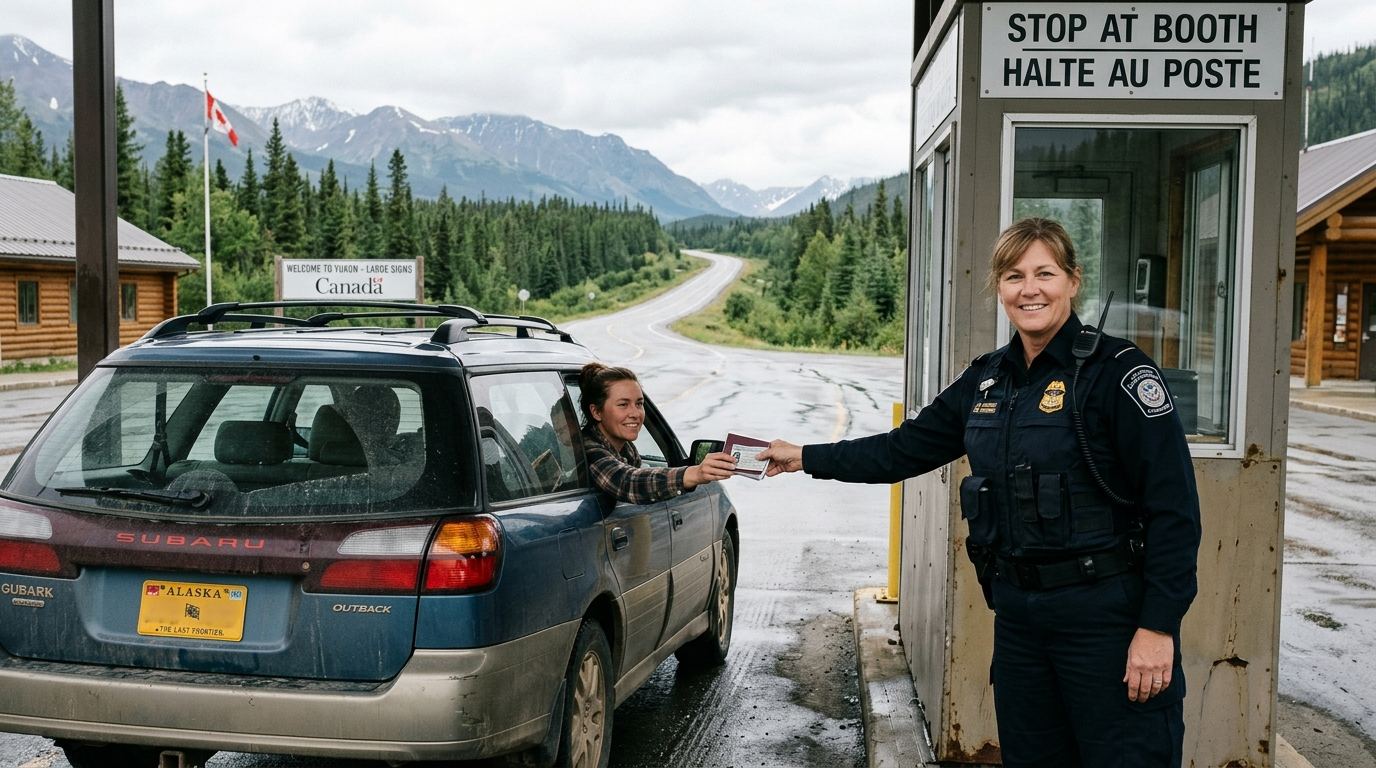
Understanding driving to alaska border crossing requirements removes anxiety at the inspection booth. When you roll up to the primary inspection lane, turn off your engine, extinguish cigarettes, remove sunglasses, roll down driver and rear passenger windows, and hand all passports to the officer in a single stack.
Border officers follow a structured line of questioning. Expect direct, standard questions:
- What is the purpose of your trip?
- How long do you plan to be in Canada?
- What is your final destination in Alaska?
- Are you carrying any firearms, weapons, or pepper spray?
- Are you transporting alcohol, tobacco, or cannabis products?
- Are you carrying currency or monetary instruments totaling ten thousand Canadian dollars or more?
Firearms create complications at the Canadian border. Canada prohibits handguns and many tactical semi-automatic rifles. Under the Canada Border Services Agency firearms regulations, hunters and wilderness travelers may transport non-restricted long guns (standard hunting rifles and shotguns) only after filing a Non-Resident Firearm Declaration (Form RCMP 5589) and paying the applicable fee. Pepper spray labeled as bear spray is permitted if the canister shows it is intended for wildlife deterrent use; personal defense sprays intended for humans are illegal. Do not conceal a weapon. Undeclared firearms result in vehicle seizure, heavy fines, and criminal charges.
Fresh produce, meat, and firewood face strict import limits to prevent the introduction of agricultural pests. A cooler packed with fresh citrus, apples, or uninspected meats can be seized and destroyed at the crossing. Buy your fresh groceries after clearing the border in Canadian towns like Dawson Creek, Fort St. John, or Whitehorse.
Cannabis remains prohibited at the border. While recreational cannabis is legal in both Canada and Alaska, moving cannabis across the international border in either direction remains a federal crime. Leave all THC products, CBD oils, and related paraphernalia at home.
Wait times vary by crossing and season. High-volume commercial border ports like Coutts/Sweet Grass in Montana or Blaine/Peace Arch in Washington can have 30 to 60 minute waits on summer weekends. Smaller crossings along the border, such as Chief Mountain in Montana or Poker Creek on the Top of the World Highway, handle far fewer vehicles but run on seasonal operating hours. Remote stations along the northern routes operate on strict schedules; confirm opening and closing times before driving long gravel detours.
If your passport is expired, lost, or expiring soon
Routine passport processing times fluctuate throughout the year. The State Department advises travelers to check processing queues months ahead of a planned trip. An expired passport is invalid on the day after its expiration date; border agents will not accept an expired passport for entry.
If your passport expires within six months of your planned crossing, renew it now. While Canada does not strictly enforce the six-month validity rule for U.S. citizens staying briefly, an expiring document risks delays if vehicle breakdowns or illness extend your trip.
If you discover an expired passport less than 14 days before your departure date, you cannot rely on routine mail-in service. You must schedule an urgent travel appointment at a regional passport agency through the U.S. Department of State passport agency system. Regional offices operate in gateway cities such as Seattle, Minneapolis, and San Francisco. These appointments require documented proof of immediate travel, such as paid lodging confirmations or ferry bookings.
If you lose your passport while driving through northern British Columbia or the Yukon, notify the local Royal Canadian Mounted Police (RCMP) detachment immediately to obtain a police report. Next, contact the nearest United States consulate. U.S. consulates in western Canada are located in Vancouver and Calgary. Replacing a passport in northern Canada requires driving back south to a consulate or coordinating with consular staff for emergency documentation.
Common myths and costly mistakes
Outdated travel advice circulates widely on internet forums. These misconceptions routinely derail road trips at the border:
The birth certificate myth: Decades ago, U.S. adults could cross into Canada using a state birth certificate and a photo driver's license. The Western Hemisphere Travel Initiative eliminated that option in 2009. Adult travelers presenting a birth certificate and standard driver's license will be denied entry into Canada.
The REAL ID confusion: A standard REAL ID driver's license meets federal identification standards for domestic airport security checkpoints inside the United States. It is not an international travel document and cannot be used to drive into Canada. Only an Enhanced Driver's License (EDL), issued by five specific northern states, functions at the land border.
Handguns for bear protection: Travelers from states with open-carry laws often pack handguns in their glove compartments for self-defense against wildlife. Canada considers handguns restricted or prohibited firearms. Packing a revolver or semi-automatic pistol into Canada without explicit, pre-approved commercial permits will cause your trip to end at the border booth.
Ignoring past criminal offenses: Canada enforces strict rules regarding past criminal convictions. A past driving under the influence (DUI or DWI) offense on a traveler's record is classified as serious criminality under Canadian immigration law. A driver with a DUI conviction is deemed inadmissible to Canada unless they have applied for and received advance rehabilitation or a Temporary Resident Permit. Attempting to drive through without resolving a past conviction risks an immediate refusal at the booth.
Where the paperwork fits in your larger trip plan
Securing the proper travel documents is only the starting line. Once your passport is secured, you must address the logistical reality of traversing 2,000 or more miles of northern highways. Driving from Seattle through Canada to central Alaska requires five to seven full days of driving each direction. First-time road trippers regularly underestimate the distances, fuel gaps, and vehicle wear involved.
Seasonal constraints dictate what you can see once you arrive. Mountain passes open late and close early. Park infrastructure operates on compressed schedules. For example, the 2026 Denali Park Road closure at mile 43 directly affects transit bus operations and wildlife viewing itineraries. Planning a trip around outdated road access maps can leave you stranded or disappointed.
Navigating these details takes time and precise field knowledge. Alaska Road Trip hand-picks lodging and gives you direct booking links, but you book it yourself—it does not make reservations on your behalf, so you keep full control and flexibility. Alaska Road Trip recommends activities and tours with timing and booking links; you reserve them yourself. Itineraries reflect current-season research at the time they're built. The trip dashboard can check available park, road, weather, and aurora data, but Alaska Road Trip does not provide real-time booking availability, live tracking, or guaranteed live condition monitoring.
DIY vs. done-for-you: what changes when someone else has driven the route
Planning an extended road trip across northern Canada into Alaska requires 20 to 40 hours of reading out-of-date guidebooks, cross-referencing road construction bulletins, and checking seasonal ferry schedules. Comparing a self-researched itinerary against a planned route illustrates the operational differences:
| Decision Criteria | DIY Trip Planning | Alaska Road Trip |
|---|---|---|
| Route Design | Trial-and-error routing using general web mapping tools | Custom day-by-day route matched to your pace and travel window |
| Route Experience | Crowdsourced advice from online message boards | Hand-built by a founder with eight Alaska trips between 2015 and 2024 |
| Pricing Model | Uncertain time investment across weeks of research | Flat fee: Lite $97, Standard $197, Plus $297 |
| Direct Consultation | None; relying on message board replies | Concierge tier ($497) adds a 30-minute live founder call |
| Offline Usability | Saved map pins that fail when cellular towers drop | Printable, offline-ready PDF delivered in 3 to 5 business days |
| Satisfaction Terms | No recourse for wasted bookings or misjudged drives | Published 14-day money-back guarantee, full refund, no questions asked |
Alaska Road Trip does not book flights or rental cars; you arrange those independently. Alaska Road Trip is a one-time flat fee, not a subscription—there are no recurring charges. Every itinerary is hand-built by a named founder who has driven these routes on eight Alaska trips between 2015 and 2024, across four seasons. The founder is not an Alaska resident or local guide; he travels the highways himself and designs routes based on firsthand road experience. Every plan comes with one to two revision rounds, letting you fine-tune drive segments before you depart.
If you prefer dedicated verbal guidance to review your route, border preparation, and packing strategy, the Concierge itinerary service provides a focused 30-minute live discussion directly with the founder.
Get the passport, then get the plan
You cannot drive to Alaska without an approved travel document. U.S. citizens must carry a valid passport book, passport card, or an Enhanced Driver's License from an eligible state. Do not leave this step to the final month of preparation.
Inspect your passport expiration dates today. If your renewal window is tight, book an appointment through the State Department or submit expedited renewal forms immediately. Once your documents are safe in your hands, shift your focus to mapping highway distances, fuel intervals, and regional closures.
Frequently asked questions
Can you drive to alaska without a passport?
No. Driving to Alaska from the contiguous United States requires passing through Canada. Under Canadian border regulations and the U.S. Western Hemisphere Travel Initiative, travelers must present a valid passport or an approved WHTI-compliant document such as an Enhanced Driver's License or passport card.
Can U.S. citizens drive to Alaska without a passport?
U.S. citizens cannot enter Canada or re-enter the United States with only a standard driver's license. While an adult U.S. citizen can use a passport card or a state-issued Enhanced Driver's License (from MI, MN, NY, VT, or WA) instead of a passport book for land travel, a standard state driver's license or birth certificate is not sufficient.
Is a passport card enough to drive through Canada to Alaska?
Yes. A U.S. passport card meets land crossing requirements for entering Canada and returning to the United States. However, it cannot be used for international air travel. If your car breaks down or you face an emergency requiring a flight home from Canada, you will need a standard passport book.
Do kids need a passport to drive to Alaska through Canada?
U.S. citizen children under age 16 can enter Canada by land with an original certified birth certificate or consular report of birth abroad. However, carrying a valid passport for every minor is strongly recommended. If a child travels with only one legal guardian, carry a signed, notarized travel consent letter from the absent parent.
What happens if I show up at the Canadian border without a passport?
Canada Border Services Agency officers will deny you entry. You will be directed to make a U-turn and return to the United States port of entry. The U.S. border officers will verify your identity, inspect your vehicle, and release you back into the Lower 48, ending your driving trip north.
If the border paperwork is settled and the route is what's keeping you up at night, start with the free trip planning guide at alaskaroadtrip.com/plan-your-trip, then decide whether a hand-built, offline-ready itinerary is worth the flat one-time fee for your dates.
See a real Alaska itinerary before you spend a dollar
A real 3-day plan with driving times, lodging picks, and a daylight chart — free, in your inbox.
One email. No spam. Unsubscribe anytime. Or view it right now — no email needed ↗
Ready for the full plan? Get your custom itinerary — from $197 · 5-day delivery →