Powering Your Alaska Adventure: An Off-Grid Power Sizing Guide for 2026
Imagine waking up to the vast, silent wilderness of Alaska, miles from the nearest town. The sun might be shining brightly at 3 AM in July, powering your roof panels, but what happens when a classic Kenai Peninsula rainstorm settles in for a week? Or when you want to cook a hot meal on an induction stove without firing up a noisy generator? For many planning their first or second self-drive Alaska road trip, the dream of off-grid freedom often bumps into the practical reality of reliable power. This isn't just about charging your phone; it's about powering your entire adventure, from camera gear to a comfortable night's sleep.
Understanding your power needs and properly sizing your battery bank is one of the most critical, yet often overlooked, aspects of preparing for an Alaskan journey. It’s a complex calculation, and getting it wrong can quickly turn a dream trip into a frustrating experience. This comprehensive off-grid power sizing guide will walk you through the essential steps to ensure your RV or camper van has the juice it needs, no matter what Alaska throws your way in 2026. We'll break down the calculations, discuss critical components, and offer practical advice tailored for the unique demands of the Last Frontier.
The sheer volume of DIY research for an Alaska trip can be overwhelming, and power systems are a prime example. But with the right approach, you can gain peace of mind and focus on the unparalleled beauty around you.
Why Off-Grid Power in Alaska Demands Special Attention
Alaska's unique environment presents distinct challenges and opportunities for off-grid power systems. While the extended daylight hours of summer can be remarkably long, offering incredibly prolonged periods of sunlight, relying solely on sunshine is a gamble. Here's why:
- Unpredictable Weather: A week of continuous rain and clouds, especially common on the Kenai Peninsula Loop or coastal areas, can severely limit solar charging. You need a backup plan.
- Vast Distances & Remote Locations: Unlike more populated regions, services are often few and far between. You might spend days in areas with no shore power hookups, requiring your system to be entirely self-sufficient. This is especially true on routes like the Denali Park Road beyond Savage River (mile 15), where amenities are minimal.
- Temperature Extremes: While summer is the primary travel season (April-October), temperatures can still drop significantly at night, particularly in higher elevations or early/late season. Cold weather affects battery performance, especially older lead-acid types.
- Desire for Comfort: Many travelers, particularly couples, families, and retirees, want to maintain a certain level of comfort – running a coffee maker, charging laptops for photo editing, or even using an induction cooktop for convenience. These devices demand substantial power.
Given these factors, a robust and accurately sized off-grid power system isn't a luxury; it's a necessity for a stress-free Alaska road trip.
The Appliance Audit: Pinpointing Your Power-Hungry Devices
The first, and arguably most critical, step in this off-grid power sizing guide is to understand exactly how much electricity you'll consume daily. This requires a thorough audit of every electrical device you plan to use. Don't guess; be specific.
Step 1: List All Electrical Devices
Start by making a comprehensive list. Think about everything you plug in or turn on:
- Lights (interior, exterior)
- Water pump
- Ventilation fans
- Refrigerator/Freezer (12V compressor type)
- Charging devices (phones, tablets, laptops, camera batteries, drone batteries)
- Entertainment (TV, sound system, gaming consoles)
- Kitchen appliances (coffee maker, toaster, microwave, induction stove, blender)
- Medical devices (CPAP machine)
- Heaters (diesel heater fan, electric blanket)
- Inverter losses (the power lost converting DC to AC)
Step 2: Determine Wattage (W) or Amperage (A) for Each Device
Look at the labels on your devices. Most will list wattage (W) or amperage (A) and voltage (V). If you only have amps, multiply by voltage to get watts (W = A x V). If you only have watts, divide by voltage to get amps (A = W / V). For 12V systems, it's often easier to work in Amp-hours (Ah).
Pay special attention to high-draw items:
- Induction Stoves: These can draw 1500-1800W, but only for short bursts.
- Coffee Makers: Often 800-1200W.
- Laptops & Camera Chargers: While individually not huge, multiple devices charging for hours can add up. Laptop chargers typically range from 45W to over 100W, depending on the device's power requirements.
Step 3: Estimate Daily Usage Hours for Each Device
Be realistic. How many hours per day will each item be actively running? For a refrigerator, this might be 24 hours, but it cycles on and off, so you'll need its average daily consumption (often provided by the manufacturer in Ah/day).
Step 4: Calculate Daily Watt-Hours (Wh) or Amp-Hours (Ah)
Multiply the device's wattage by its daily usage hours to get Watt-hours (Wh). For 12V systems, it's often more practical to calculate Amp-hours (Ah) directly:
Daily Ah = (Device Amps) x (Daily Usage Hours)
Example Daily Power Consumption (12V System):
| Device | Amps (A) | Daily Usage (Hours) | Daily Ah |
|---|---|---|---|
| LED Lights | 2 | 4 | 8 |
| Water Pump | 5 | 0.25 (15 min) | 1.25 |
| 12V Fridge | 4 (avg) | 24 (cycling) | 96 |
| Laptop Charging | 5 (60W/12V) | 3 | 15 |
| Phone Charging (x2) | 1 (each) | 2 | 4 |
| Induction Stove | 125 (1500W/12V) | 0.25 (15 min) | 31.25 |
| Inverter Idle/Losses | 1 | 24 | 24 |
| TOTAL ESTIMATED DAILY AH CONSUMPTION | |||
This example shows a significant daily draw, especially with an induction stove. Your total will vary, but this detailed approach is key to accurate sizing.
From Daily Usage to Battery Bank Capacity: Sizing Your Storage
Once you have your total daily Amp-hour consumption, you can determine the size of the battery bank you need. This is where battery chemistry and desired "days of autonomy" come into play.
Battery Types: Choosing Wisely for Alaska
For RV and camper van applications, especially in Alaska, Lithium Iron Phosphate (LiFePO4) batteries are the gold standard. While more expensive upfront, their benefits far outweigh the cost for serious off-grid travel:
- Lead-Acid (Flooded/AGM): These are cheaper but have significant drawbacks. They typically allow for only about 50% of their rated capacity to be used safely without significantly shortening their lifespan, are considerably heavier, and their performance can degrade substantially in cold temperatures. They also have a shorter cycle life. For a detailed comparison of battery types, resources like Battle Born Batteries offer further insights.
- LiFePO4 (Lithium Iron Phosphate): These batteries offer superior usable capacity, typically allowing for 80-100% depth of discharge, are much lighter, have a significantly longer lifespan (thousands of cycles), and maintain voltage better under load. Many modern LiFePO4 batteries include internal heating elements for cold weather charging, which is crucial for Alaska. For more detailed information on LiFePO4 technology and its advantages, you can consult resources like Battle Born Batteries.
Understanding Depth of Discharge (DoD) and Usable Capacity
This is critical. A 100Ah lead-acid battery only provides about 50Ah of usable power. A 100Ah LiFePO4 battery provides 80-100Ah. It's crucial to factor in usable capacity when calculating.
Calculating Required Battery Bank Ah
You need to decide how many "days of autonomy" you want – meaning, how many days you can run your system without any charging input (e.g., solar, alternator). For Alaska's unpredictable weather and remote locations, aiming for several days of autonomy, or at least a robust backup plan, is a sensible approach to provide a buffer.
Formula:
Required Battery Bank Ah = (Total Daily Ah Consumption) x (Desired Days of Autonomy) / (Usable Depth of Discharge %)
Using our example of 171.5 Ah daily consumption and aiming for 3 days of autonomy with LiFePO4 (assuming many usable DoD):
Required Battery Bank Ah = (171.5 Ah) x (3 days) / (0.90) = 514.5 Ah / 0.90 = 571.67 Ah
So, you would need a battery bank of approximately 570-600 Amp-hours (at 12V) to comfortably power your example setup for three days without charging. This might translate to three 200Ah LiFePO4 batteries.
Keeping Your Batteries Charged: Alaskan Charging Strategies
A large battery bank is only useful if you can recharge it. Alaska's environment influences the effectiveness of different charging methods.
Solar Panels: Harnessing the Midnight Sun (When it Shines)
Solar is fantastic for silent, renewable charging. However, as mentioned, Alaska's weather can be fickle. Sizing your solar array means calculating how many watts you need to replenish your daily draw, factoring in average sun hours and potential cloudy days.
- Sizing: A general rule of thumb for solar panel sizing is to calculate your daily Watt-hour consumption, multiply by an inefficiency factor (e.g., 1.5), and then divide by your average peak sun hours to determine the required solar panel wattage. So, for 171.5 Ah (approx. 2058 Wh at 12V), you might aim for 600-800W of solar panels.
- MPPT Charge Controller: Essential for maximizing efficiency, especially in varying light conditions.
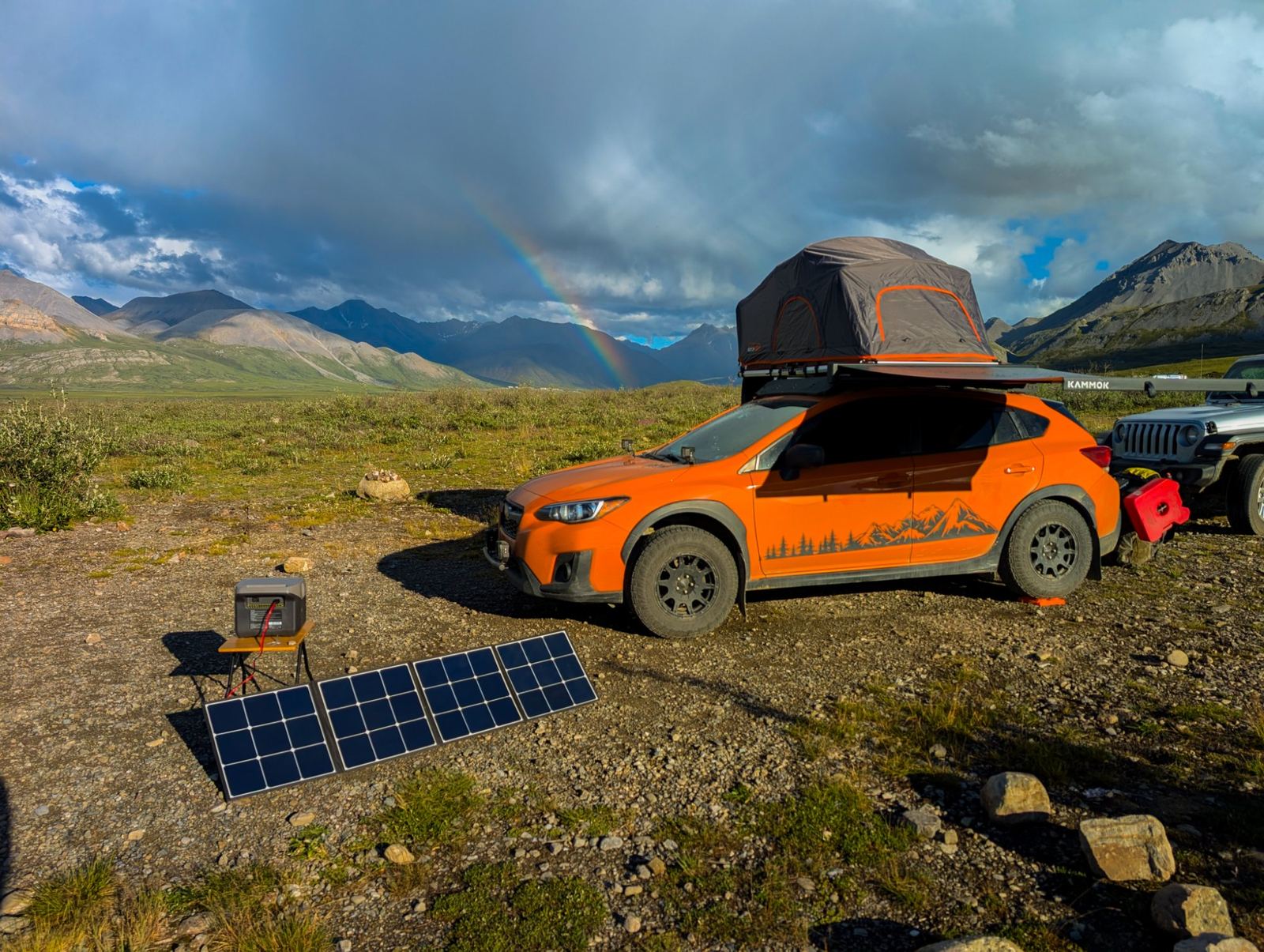
- Placement: Consider portable panels in addition to roof-mounted ones to chase the sun or avoid tree shade.
Alternator Charging (DC-DC Charger): Your Road Trip Lifeline
For an Alaska road trip, a DC-DC charger that utilizes your vehicle's alternator to charge your house batteries is absolutely critical. You'll be driving long distances between destinations, and this is often the most reliable way to replenish your battery bank, especially during extended cloudy periods.
- Efficiency: Modern DC-DC chargers are highly efficient and can deliver significant amperage (e.g., 40-60+ amps) while you drive.
- Smart Charging: They protect your vehicle's starter battery and ensure your house batteries receive the correct charging profile.
Shore Power & Generators: Backup Options
While less "off-grid," having the option to plug into shore power at campgrounds or use a portable generator can be a lifesaver during prolonged bad weather or if you have exceptionally high power demands. However, many truly remote Alaska campsites won't offer these amenities.
The Unsung Hero: Why a Smart Shunt is Non-Negotiable
You've invested in a robust battery bank and charging system. Now, how do you know how much power you actually have left? This is where a reliable monitoring system, specifically a smart shunt, becomes critical for wilderness peace of mind.
Many first-time RVers rely on simple voltage meters, which are notoriously inaccurate for determining battery state of charge (SoC), especially with LiFePO4 batteries. A voltage meter might show a healthy 13V, but your battery could be nearly empty under load.
A smart shunt, like those offered by Victron Energy, is a precision instrument that measures every amp-hour going into and out of your battery bank. It provides:
- Accurate State of Charge (SoC): You'll know exactly what percentage of power you have left, just like your phone's battery indicator.
- Real-time Current Flow: See how many amps are being drawn by your appliances and how many are coming in from your solar panels or DC-DC charger.
- Voltage & Temperature: Essential data for monitoring battery health.
- Historical Data: Track your consumption patterns over time, helping you refine your usage habits.
With a smart shunt, you eliminate the guesswork. You can confidently run your induction stove, charge your camera gear, or use your CPAP machine knowing precisely how much power you have in reserve. This level of insight is invaluable when you're days away from the nearest town and relying entirely on your off-grid system.
Beyond the Numbers: Real-World Alaska Power System Considerations
While calculations are essential, real-world factors in Alaska can influence your system's performance and your overall experience.
- Cold Weather Performance: If traveling in shoulder seasons (April/May or September/October), ensure your LiFePO4 batteries have low-temperature charging protection or internal heaters. Charging lithium batteries below freezing can damage them.
- Weight and Space: A large battery bank and solar array add weight and take up space. Consider the payload capacity of your RV or van. For insights into vehicle choices, read our guide on RV vs. Car for an Alaska Road Trip.
- Installation Safety: Proper fusing, wire gauge, and component selection are paramount. If you're not experienced with electrical systems, consider professional installation. Incorrect wiring can be dangerous and costly. For general RV electrical safety, resources like RV Travel offer valuable tips.
- The "What If" Scenario: What if you encounter a week of heavy rain and fog, your DC-DC charger malfunctions, or you decide to stay an extra day in a remote spot? Your battery bank and charging strategy should have enough redundancy to handle unexpected situations.
Planning an off-grid power system for Alaska is a significant undertaking, requiring careful research and attention to detail. It's just one piece of the larger puzzle of planning a truly memorable and stress-free Alaska road trip. The complexity of these DIY tasks can quickly become overwhelming, leading many to question if they should tackle it all themselves or seek expert guidance.
Frequently Asked Questions
How much solar do I really need for an Alaska road trip?
The amount of solar you need depends directly on your daily power consumption and your desired days of autonomy. While Alaska's summer offers long daylight, cloud cover is common. A good starting point is to calculate your daily Watt-hour consumption, multiply by an inefficiency factor (e.g., 1.5), and then divide by your average peak sun hours to determine the required solar panel wattage. For example, if you use 150 Ah daily, you might target 300-400W of solar panels. However, often prioritize a robust DC-DC charger for reliable charging while driving.
Can I just use a generator instead of a large battery bank?
While a generator can provide power, it comes with drawbacks. Generators are noisy, consume fuel, and are often restricted in national parks and quiet campgrounds. They also require you to be present to operate them. A well-sized battery bank with multiple charging sources (solar, DC-DC) offers silent, continuous power, which is often preferred for enjoying the tranquility of Alaska's wilderness. A generator can serve as a backup, but it's rarely a primary solution for extended off-grid living.
What's the best battery type for an Alaska RV trip?
For an Alaska RV trip, Lithium Iron Phosphate (LiFePO4) batteries are highly recommended. They offer superior usable capacity (typically 80-100% depth of discharge compared to around 50% for lead-acid batteries), are significantly lighter, have a much longer lifespan, and perform better in varying temperatures (especially those with internal heaters for cold charging). While the initial cost is higher, their long-term value, performance, and peace of mind make them an ideal choice for demanding off-grid adventures in Alaska, as detailed by battery experts like Battle Born Batteries.
How long will my off-grid battery bank last in Alaska?
The lifespan of your battery bank (how many days it can power your devices without charging) depends on two main factors: your total daily Amp-hour consumption and the usable capacity of your battery bank. After calculating your daily usage, you can determine how many days your battery bank can sustain that usage before needing a recharge. For Alaska, considering several days of autonomy is a prudent approach to account for unpredictable weather and remote locations where charging opportunities might be scarce.
Ready for a Seamless Alaska Road Trip?
Mastering your off-grid power system is a crucial step toward a successful Alaska road trip, but it's just one of many complex decisions you'll face. From navigating potential road closures to finding available lodging and planning efficient routes, the DIY research can quickly become overwhelming. If you're feeling the weight of planning every intricate detail, remember that you don't have to go it alone. For a deeper dive into the benefits of professional planning, explore our comparison of Alaska Trip Planner vs. DIY.
Our founder, who has driven thousands of miles across multiple seasons, hand-builds custom day-by-day Alaska road trip itineraries tailored to your interests and travel style. We provide a printable, offline-ready PDF in 3-5 business days, with 1-2 revision rounds, recommending lodging and activities with direct booking links (you book directly). We offer transparent flat fees across various custom trip plan tiers, including Lite, Standard, Plus, and Concierge options, each designed to match different trip durations and levels of support. With a 14-day money-back guarantee, we take the guesswork out of your adventure. Let us handle the intricate planning so you can focus on the unparalleled beauty of Alaska. Start planning your custom Alaska road trip today.

See a real Alaska itinerary before you spend a dollar
A real 3-day plan with driving times, lodging picks, and a daylight chart — free, in your inbox.
One email. No spam. Unsubscribe anytime. Or view it right now — no email needed ↗
Ready for the full plan? Get your custom itinerary — from $197 · 5-day delivery →