You do not need to trek ten miles with crampons and ice axes across technical moraine to touch ancient blue ice. Several of the most spectacular accessible glaciers in Alaska sit directly off paved state highways or require only a flat, paved stroll from a parking lot.
For retirees, families with small children, travelers with mobility limitations, or road-trippers who simply want world-class ice views without an exhausting alpine ascent, Alaska offers a wide range of drive-up, boat-access, and flat-path glacier encounters. This guide covers exactly where to go, what physical effort is required, parking logistics, and how to fit these road-accessible glaciers into your self-drive route.
Understanding Glacier Accessibility in Alaska
Glacier terrain in Alaska varies dramatically. While some glaciers require backcountry bush flights or multi-day mountaineering traverses, others terminate directly in roadside lakes, valleys, or fjords accessible via Alaska's primary highway system. When evaluating glacier access for non-hikers, sites generally fall into three distinct tiers of physical effort:
- Drive-up viewpoints: Glaciers you can see directly from your vehicle or from an adjacent paved highway pullout without walking more than fifty feet.
- Paved or flat gravel nature walks: Well-maintained paths under one mile round-trip with minimal elevation change (less than 50 feet), suitable for wheelchairs, strollers, and travelers who use walking canes.
- Supported vehicle or boat excursions: Non-hiking tours such as day cruises, historic train routes, or guided road shuttles where the transport takes you directly to the ice face.
Knowing these distinctions prevents painful surprises. Many travel forums describe a trail as "easy" because it is technically non-climbing, yet it may still involve two miles of uneven river stones, slippery roots, and loose glacial silt that pose real hazards for non-hikers.
The Top Road-Accessible Glaciers in Alaska
Alaska's paved highway network connects you directly to several major icefields. If you are planning a route across Southcentral or the Interior, these are the top glaciers you can reach without backcountry hiking.
1. Matanuska Glacier (Glenn Highway)
Located at Mile 102 on the Glenn Highway (roughly a two-hour drive northeast of Anchorage), Matanuska Glacier is the largest road-accessible glacier in the United States. Spanning 27 miles long and four miles wide at its terminus, it offers the closest physical access to ice that you can reach by passenger vehicle.
The Non-Hiker Experience: You have two distinct ways to experience Matanuska:
- Highway Pullouts and State Recreation Site: For a completely free, zero-exertion view, stop at the Matanuska Glacier State Recreation Site (Mile 101) or the roadside pullouts between Miles 101 and 105. The state rec site features an interpretive viewing platform nestled in the boreal forest with clear panoramic views of the glacier terminus.
- Glacier Park Access (Guided Walking Access): Access to walk directly to and onto the ice is managed through private land at Glacier Park. Independent unguided walking on the ice is no longer permitted for safety reasons; all foot access onto the ice requires a guided tour. Guides provide microspikes that slip over your walking shoes. While walking on the ice requires basic balance, the path from the private staging area to the edge of the ice is short, and tours move at a gentle, methodical walking pace.
Logistics & Fees: Roadside pullouts are free. The State Recreation Site charges a standard state parking day-use fee (or Alaska State Parks annual pass). Guided access through the private park operator requires an admission ticket or tour booking, and reservations should be secured in advance during peak summer months (June through August).
2. Exit Glacier (Kenai Fjords National Park / Seward)
Exit Glacier is the only section of Kenai Fjords National Park accessible by road. Situated at the end of Herman Leirer Road (Exit Glacier Road), eight miles outside Seward, this site is ideal for visitors driving the Seward Highway route.
The Non-Hiker Experience: The Exit Glacier Nature Center serves as the trailhead for several paths. Non-hikers should avoid the strenuous 8.2-mile Harding Icefield Trail and focus exclusively on the accessible lower loops:
- Glacier View Loop Trail: A fully paved, ADA-accessible 1-mile loop through cottonwood forest to an open viewing platform. The platform provides a direct, elevated vantage point of the glacier spilling down from the Harding Icefield. Wheelchairs, motorized chairs, and strollers navigate this path with ease.
- Glacier Touch / Lower Outwash Plain: Branching off the paved trail is a gently graded gravel path that leads closer to the outwash plain. While gravel, it remains wide and relatively flat, though pushing a standard wheelchair requires slightly more effort than on the paved loop.
Logistics & Fees: Kenai Fjords National Park does not charge an entrance fee at the Exit Glacier area. Parking is free, but the lot frequently fills between 10:30 AM and 3:30 PM from mid-June through August. Arrive before 9:30 AM or after 4:30 PM for effortless parking.
3. Worthington Glacier (Richardson Highway / Thompson Pass)
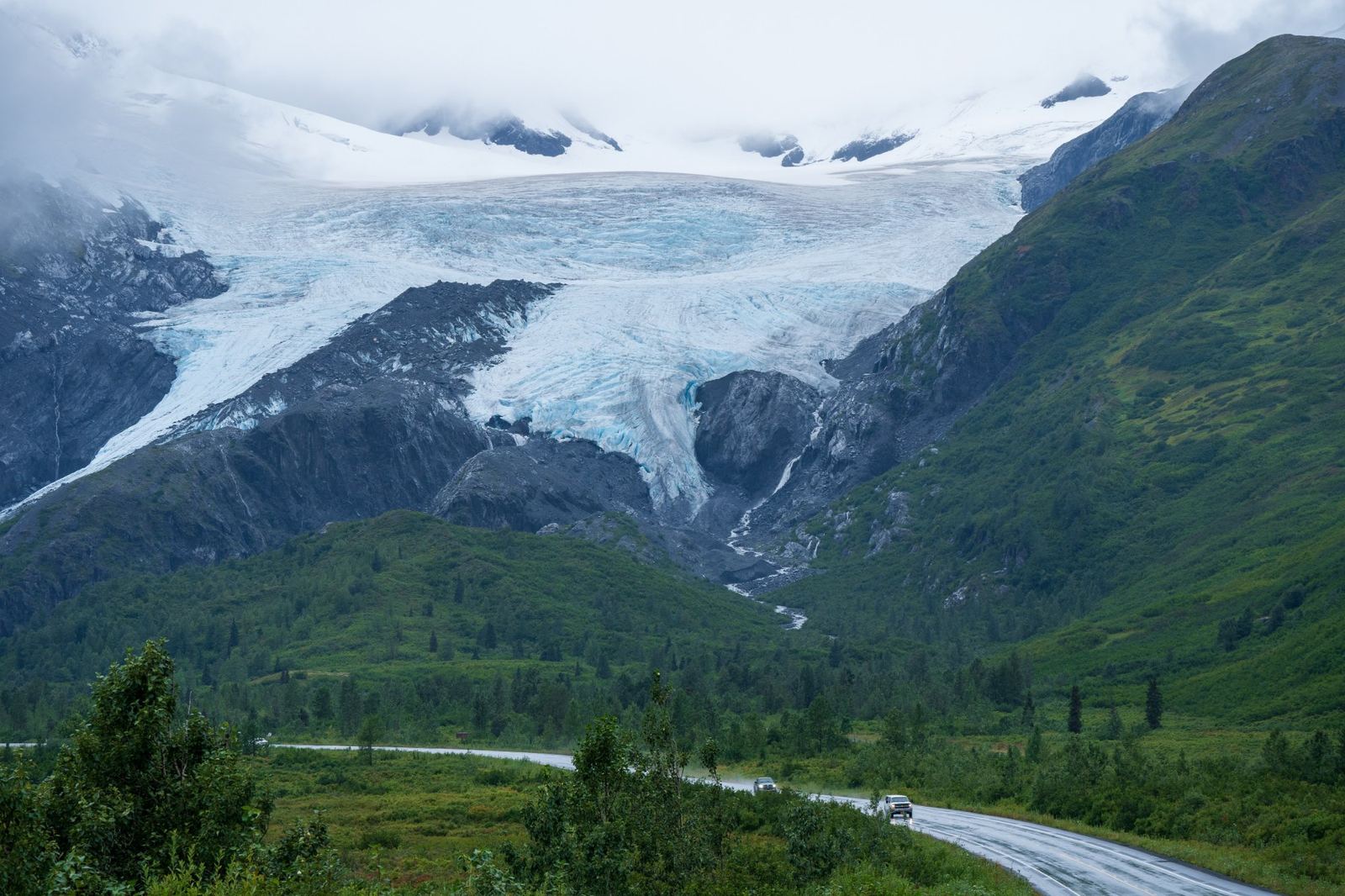
Perched near the crest of Thompson Pass at Mile 28.7 of the Richardson Highway, about 30 miles northeast of Valdez, Worthington Glacier is a designated National Natural Landmark and arguably the most dramatic roadside glacier in Prince William Sound's mountain rim.
The Non-Hiker Experience: The Worthington Glacier State Recreation Site places you remarkably close to the ice with almost zero effort:
- Viewing Shelter & Paved Walkway: From the paved parking area, a smooth, paved pathway leads directly to a sheltered viewing pavilion overlooking the glacial tarn and the tumbling blue seracs of the glacier face.
- Moraine Trail: A wider gravel path leads slightly closer to the terminal moraine. It has gentle grades, though footwear with solid traction is helpful if you venture onto the unpaved surface.
Logistics & Fees: The site operates under the Alaska Division of Parks and Outdoor Recreation and requires a modest daily parking fee paid at an automated kiosk or self-pay pipe. The site is open seasonally, generally from late May through late September, depending on snowpack on Thompson Pass.
4. Portage Glacier & Byron Glacier (Turnagain Arm / Portage Valley)
Located roughly 50 miles south of Anchorage at the end of Turnagain Arm, Portage Valley is packed with accessible ice features fed by the Southern Kenai Mountains.
The Non-Hiker Experience: Portage Glacier itself has receded around a mountain corner and is no longer visible from the Begich, Boggs Visitor Center parking lot. However, non-hikers have two effortless ways to see it:
- MV Ptarmigan Day Cruise: An enclosed, heated boat that departs from the Portage Lake dock (steps from the parking lot) for a 1-hour cruise directly to the towering face of Portage Glacier. You can sit inside behind large viewing windows or step out onto the flat deck.
- Byron Glacier Trail (Near Portage Lake): Located just down the road from the visitor center, Byron Glacier Trail is an exceptionally gentle, flat, wide 1.4-mile round-trip gravel walk through alder and cottonwood trees along a glacial creek. It offers non-hikers views of hanging glaciers, snowfields, and Byron Glacier's tongue without steep climbing.
Logistics & Fees: Parking at the Begich, Boggs Visitor Center is managed by the US Forest Service and requires a standard day-use fee or valid interagency pass. The visitor center itself is fully accessible, featuring massive floor-to-ceiling windows, interactive glaciology exhibits, and actual chunks of glacial ice harvested from the lake.
5. Castner Glacier (Richardson Highway / Eastern Alaska Range)
For adventurous drivers exploring the interior Richardson Highway between Delta Junction and Paxson (Mile 217.3), Castner Glacier offers roadside visibility of a debris-covered valley glacier framed by the sharp peaks of the Eastern Alaska Range.
The Non-Hiker Experience: While hikers frequently trek along the creek to the terminus, non-hikers can view the expansive glacial valley and terminal moraine directly from the bridge and wide gravel highway pullouts. Caveat: Walking up to the ice cave at Castner is not recommended for non-hikers due to unstable moraine rocks, river braiding, and significant ice-collapse hazards documented by glaciologists.
Comparison of Non-Hiker Glacier Access
To help you decide which stops fit your physical comfort level and daily driving schedule, compare the primary accessible glaciers in Alaska below:
| Glacier Name | Highway / Location | Walking Distance to View | Surface & Terrain | Estimated Cost |
|---|---|---|---|---|
| Matanuska Glacier (State Rec Site) | Glenn Hwy MP 101 | < 200 feet | Paved deck / flat gravel | Day-use parking fee |
| Matanuska Glacier (On-Ice Walk) | Glenn Hwy MP 102 | 0.25–0.5 miles | Uneven gravel & microspike ice path | Guided tour ticket |
| Exit Glacier (Glacier View Loop) | Exit Glacier Rd (Seward) | 1.0 mile round-trip | Paved, ADA accessible | Free entrance |
| Worthington Glacier | Richardson Hwy MP 28.7 | < 400 feet | Paved walkway & viewing shelter | Day-use parking fee |
| Portage Glacier (MV Ptarmigan) | Portage Valley Rd | Steps from car to boat | Enclosed passenger vessel | Scenic cruise fare |
| Mendenhall Glacier | Juneau (Inside Passage) | 0.25 miles | Paved paths / elevated visitor center | USFS visitor fee |
Glacier Viewing by Boat, Train, and Air
If walking on natural trails is entirely off the table, or if you want to witness active tidewater calving (where skyscraper-sized chunks of ice crash into the ocean), vehicle-supported glacier tours provide unmatched access.
1. Kenai Fjords and Prince William Sound Day Cruises
Tidewater glaciers can only be viewed from the water or the air. Small-ship day cruises operating out of Seward and Whittier give non-hikers front-row seats to monumental glaciers like Aialik Glacier, Holgate Glacier, or Surprise Glacier without taking a single hiking step.
Cruises out of Whittier navigate the calm, protected waters of Prince William Sound, making them an outstanding choice for travelers prone to motion sickness. Catamarans pull within hundreds of yards of sheer vertical ice faces, idling their engines so passengers can hear the crack of the ice—known locally as "white thunder"—from comfortable, heated indoor cabins.
2. Alaska Railroad: Glacier Discovery Train
The Alaska Railroad operates the Glacier Discovery route out of Anchorage, stopping at Portage, Whittier, and the remote Spencer Glacier Whistle Stop. Non-hikers can view Spencer Glacier across the lake from the train or pair the ride with a flat, motorized raft tour that floats past grounded blue icebergs without requiring physical paddling effort.
3. Glacier Flightseeing with Glacier Landings
For the ultimate non-hiker splurge, ski-plane and helicopter operators in Talkeetna, Anchorage, Palmer, and Girdwood fly passengers directly into high-altitude amphitheaters and land on active ice sheets. You step out of the aircraft directly onto thousands of feet of compressed snow and ice, surrounded by jagged granite peaks, requiring only a few steps around the aircraft skids.
Essential Practical Tips for Non-Hiker Glacier Trips
Visiting glacial environments requires specific preparation, even if your itinerary involves zero technical hiking. Glacial valleys generate their own microclimates characterized by katabatic winds (dense, cold air flowing down from the icefield), frequent rain showers, and intense light reflection.
1. Footwear Matters Even on Short Walks
Even on paved paths like Exit Glacier or Worthington Glacier, wet glacial silt can make surfaces slick. Leave open-toed sandals and smooth-soled running shoes in your luggage. Wear sturdy walking shoes or lightweight trail shoes with deep rubber tread (such as Vibram soles) to maintain solid grip on damp walkways, wooden observation decks, and fine gravel.
2. Dress for Glacier Microclimates
The ambient temperature standing 300 yards from a massive body of ice is often 10 to 15 degrees Fahrenheit colder than the surrounding highway temperature. Always pack a warm fleece or packable down jacket, a windproof and waterproof outer shell, a light beanie, and gloves in your daypack, even on a sunny summer afternoon. Review our Alaska road trip packing list for detailed layering recommendations.
3. Glare and Eye Protection
Glacier ice and outwash plains reflect immense amounts of ultraviolet radiation. Polarized sunglasses are essential to cut the blinding white glare and reveal the deep, saturated blues hidden inside ice crevasses and moulins.
4. Route Timing and Summer Crowds
Most roadside glacier sites experience peak congestion between 11:00 AM and 3:00 PM when tour buses transit between Anchorage, Seward, and Valdez. For serene visits and easier access to designated accessible parking spaces, plan your stops for early morning (before 9:30 AM) or late afternoon during Alaska's long summer daylight hours. Learn more about seasonal timing in our guide to the best time for an Alaska road trip.
How to Build Glaciers into Your Custom Road Trip
Mapping out a multi-day driving route that balances drive times, accessible viewpoints, scenic highway legs, and comfortable lodging can quickly become overwhelming. Trying to piece together travel forums, conflicting trail difficulty ratings, and seasonal parking restrictions often leads to over-scheduled days and unnecessary physical strain.
At Alaska Road Trip, we take the stress out of your vacation planning. Every custom itinerary is hand-built by a named founder who has driven thousands of Alaska miles across multiple seasons. Whether you are traveling as a couple, bringing grandchildren, or managing mobility limitations, we craft realistic, day-by-day self-drive plans tailored to your exact pacing preferences.
Our service provides a clear, printable, offline-ready PDF delivered within 3 to 5 business days (including 1 to 2 revision rounds) across our structured packages: Lite (1–5 days), Standard (up to 14 days), Plus (15+ days), or Concierge (which includes a 30-minute live founder consultation call). Alaska Road Trip hand-picks lodging and activities and gives you direct booking links so you retain complete control over your reservations—we recommend the best spots and timing, while you book directly. Itineraries reflect current-season research, including updated park road and transit schedules.
Frequently Asked Questions
What is the easiest glacier to see by car in Alaska?
Worthington Glacier on the Richardson Highway and Matanuska Glacier on the Glenn Highway are the easiest to see directly from your vehicle. Both feature paved roadside pullouts with direct line-of-sight views of the ice face without leaving your car.
Can you walk on a glacier in Alaska without hiking?
Yes. At Matanuska Glacier, guided tours take visitors from the base parking area directly onto the ice along a short, managed path using slip-on microspikes. Alternatively, helicopter flightseeing tours land directly on top of glaciers, allowing you to step right out onto the ice sheet without any preliminary hiking.
Is Exit Glacier wheelchair accessible?
Yes. The lower Glacier View Loop Trail at Exit Glacier in Kenai Fjords National Park is fully paved, gently graded, and ADA-compliant, leading to an elevated viewing platform overlooking the glacier terminus.
Do I need crampons to see roadside glaciers?
No. Crampons are only required for technical glacier mountaineering or ice climbing. Viewing roadside glaciers from paved platforms and flat gravel paths requires only standard walking shoes. If you take a guided walking tour onto the surface of Matanuska Glacier, the operator provides simple slip-on traction microspikes that attach over ordinary closed-toe shoes.
Are glacier boat cruises suitable for travelers with limited mobility?
Yes. Day cruise vessels operating out of Whittier, Seward, and Valdez are large, stable catamarans and monohulls equipped with wide boarding ramps, accessible main-deck cabins, large picture windows, and accessible restrooms, allowing non-hikers to view tidewater glaciers in comfort.
Ready to experience Alaska's glaciers without the physical burnout of DIY guesswork? Explore our custom Alaska road trip planning options today and let a local expert design your ideal driving route.
See a real Alaska itinerary before you spend a dollar
A real 3-day plan with driving times, lodging picks, and a daylight chart — free, in your inbox.
One email. No spam. Unsubscribe anytime. Or view it right now — no email needed ↗
Ready for the full plan? Get your custom itinerary — from $197 · 5-day delivery →