
Yes, you can legally off-road in Alaska on designated public trails, but you cannot take a standard rental car off paved roads without violating your rental agreement. If you are asking whether can you off road in alaska during a self-drive vacation, the legal reality and the practical rental logistics are two completely different hurdles.
Most travelers imagine renting an SUV at the Anchorage or Fairbanks airport and steering onto gravel riverbeds, mountain ridgelines, or remote tundra. In reality, Alaska strictly governs where motorized vehicles can travel, while commercial rental car agencies forbid unpaved travel altogether. Navigating these rules requires knowing the difference between established gravel highways, legal off-highway vehicle (OHV) trail systems, and forbidden backcountry terrain.
The short answer: yes, with two big caveats
Can you off road in Alaska? Yes, motorized travel is legal across designated state land, borough trail networks, and selected federal public land areas. However, two primary barriers catch first-time and second-time visitors off guard: land jurisdiction and rental vehicle contracts.
First, true off-road terrain is rarely open to unrestricted driving. Alaska is not an open expanse where you can point a 4x4 across open tundra. Vehicle tracks over delicate permafrost leave scars that persist for decades, prompting state and federal land managers to enforce designated-trail rules strictly. Driving across private parcels or regional Alaska Native corporation land without explicit land-use permits constitutes criminal trespass.
Second, almost every standard vehicle rented from a major airport fleet comes with a contract that restricts driving to maintained, paved surfaces. Taking a conventional rental SUV onto a gravel trail, an unmaintained mining road, or even certain named state highways voids your insurance coverage and leaves you liable for recovery bills that can exceed several thousand dollars.
To plan your route properly, distinguish between three driving categories that travelers routinely conflate:
- True off-road trail driving: Navigating unmaintained dirt tracks, boulder fields, washouts, and mud bogs in an ATV, utility task vehicle (UTV), or specialized high-clearance 4x4 equipped with recovery winches.
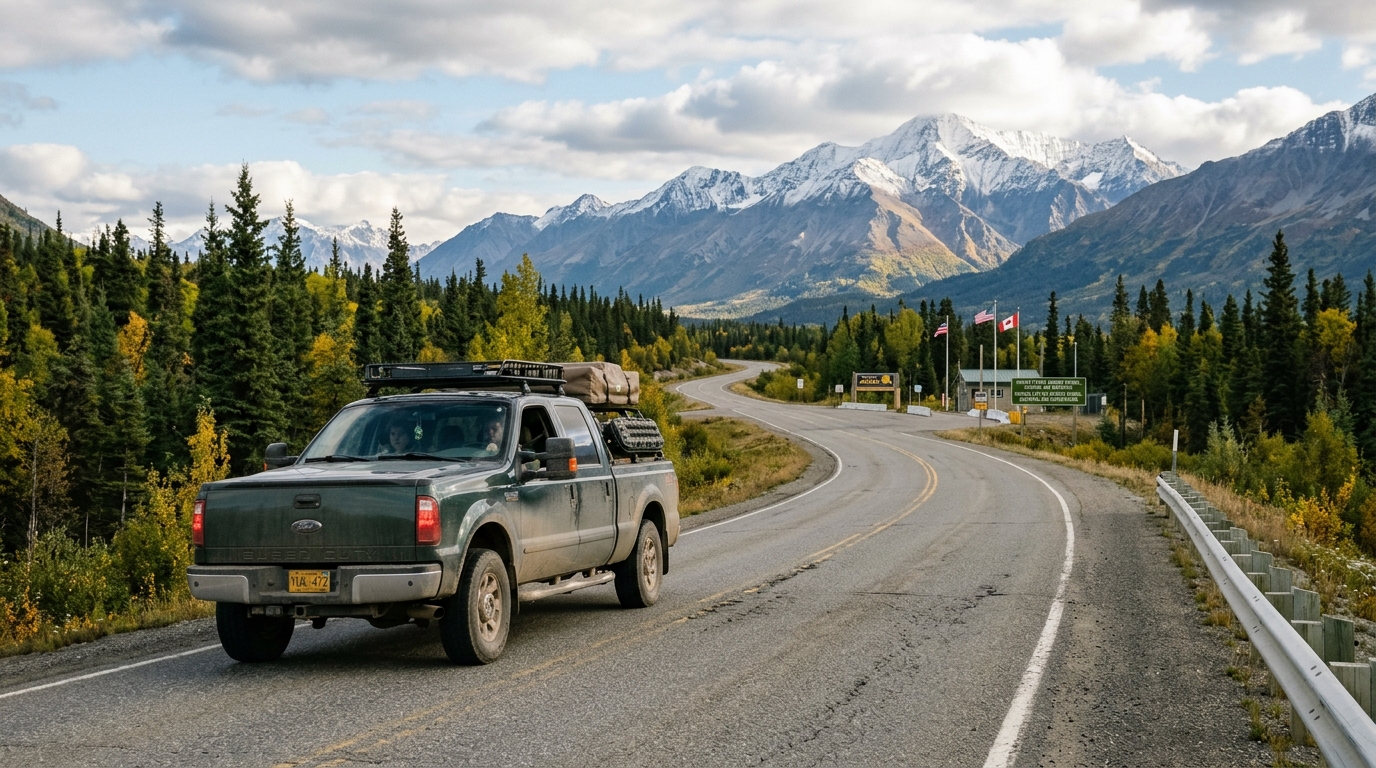
- Driving remote gravel highways: Traveling designated, state-maintained public thoroughfares such as the Denali Highway, McCarthy Road, or Dalton Highway in a street-legal vehicle that is permitted by your rental agency.
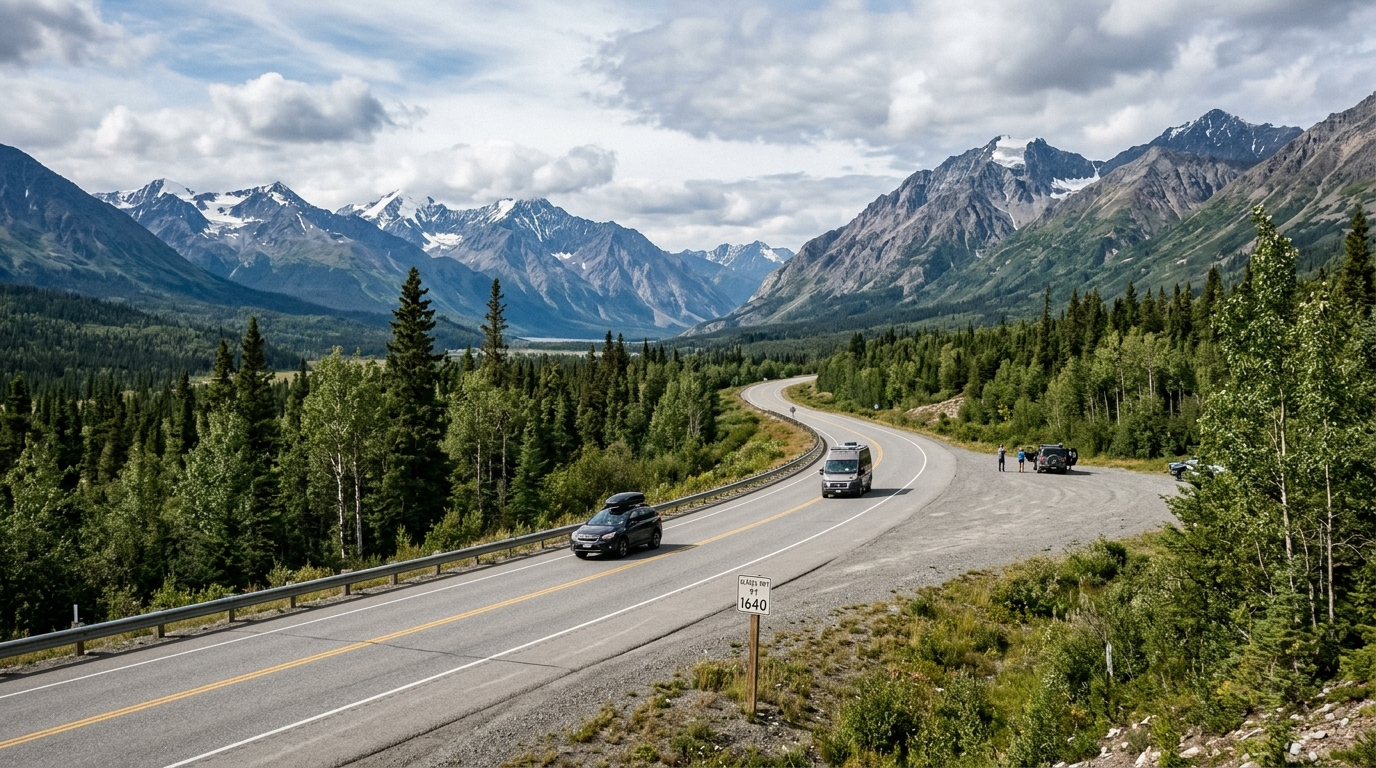
- Pulling onto road shoulders and scenic pullouts: Stopping temporarily on hard-packed gravel turnouts along paved routes like the Seward Highway or Parks Highway, which is standard practice and permitted by all rental companies.
For most vacation itineraries, the sensible way to experience Alaska backcountry driving is either traveling a state-maintained gravel highway in an authorized vehicle or booking a guided off-road excursion that supplies its own equipment.
What counts as off-roading in Alaska
Alaska spans over 365 million acres, managed by a patchwork of federal agencies, state departments, regional Native corporations, and municipal boroughs. Each entity enforces its own motorized travel framework.
Public land access varies significantly between agencies. The U.S. Bureau of Land Management permits off-highway vehicle recreation on designated trails and open management areas, but restricts motorized access in sensitive wilderness study zones. Conversely, the National Park Service heavily limits private vehicle travel. The National Park Service prohibits private vehicles past mile 15 of the 92-mile Denali Park Road corridor, requiring travelers to board transit buses. For travelers planning around Denali, road access faces further operational limits due to the ongoing Pretty Rocks landslide repair near mile 43, explained in our review of Denali Park Road access through 2026.
Designated motorized recreation areas do exist near population hubs. The Matanuska-Susitna Borough maintains dedicated trail systems near Palmer, Wasilla, and Sutton, providing access to glacial floodplains and gravel river bars. Further north, the historic mining districts surrounding Fairbanks, Central, and Nome feature publicly accessible dirt tracks built during early mineral exploration eras.
Travelers often mistake Alaska's remote, unpaved state highways for off-road routes. The Dalton Highway (Route 11), Denali Highway (Route 8), McCarthy Road, Steese Highway (Route 6), and Taylor Highway (Route 5) are public state roads. They are unpaved, narrow, remote, and rough, yet they appear on state road maps and receive summer maintenance from the Alaska Department of Transportation and Public Facilities. These routes are unpaved public highways with mechanical and logistical challenges similar to dirt trails.
Large tracts of wilderness belong to Alaska Native Regional and Village Corporations established under the Alaska Native Claims Settlement Act (ANCSA) of 1971. These are private lands held for cultural preservation, resource management, and shareholder benefit. Entering corporation land to hunt, camp, fish, or drive an OHV requires an authorized land-use permit from the specific regional or village corporation. Do not assume unfenced backcountry is open for public motorized exploration.
Alaska off-road trails worth knowing about
If your goal is navigating genuine trail systems with an ATV, side-by-side, or modified 4x4, several established regions accommodate legal off-roading in Alaska.
Mat-Su Valley trail systems
Located roughly an hour northeast of Anchorage, the Mat-Su Borough provides the most accessible off-highway terrain in Southcentral Alaska. The Jim Creek Recreation Area and the Knik River Public Use Area feature braided riverbeds, silt flats, and forested dirt trails. Drivers frequent this zone to approach the terminus of Knik Glacier. Silt flats can conceal deep quicksand-like mud pits that trap vehicles instantly, making travel in pairs with adequate recovery gear essential.
Nome road system and backcountry
Nome offers roughly 350 miles of gravel tracks branching across the Seward Peninsula, isolated completely from the contiguous highway grid. Roads like the Kougarok Road, Teller Highway, and Council Road cross tundra landscapes, river valleys, and historic gold-dredge sites. While these are maintained secondary roads, the remote terrain demands rigorous self-sufficiency, two spare tires, and satellite communication equipment.
Fairbanks mining corridors and the Steese Highway
Interior Alaska contains hundreds of miles of public mining access roads branching off the Steese and Elliott highways. Trails in the White Mountains National Recreation Area provide motorized summer routes on designated corridors, leading to limestone ridges, boreal forest tracks, and rustic public-use cabins. Specific trail seasonal dates protect wet soils during the spring thaw.
The guided tour alternative
For couples, families, and retirees, driving an unfamiliar backcountry trail in a self-rented 4x4 introduces excessive mechanical and safety liabilities. Guided ATV or side-by-side excursions near Healy, Denali, Talkeetna, or Fairbanks supply the machines, fuel, safety gear, and local trail navigation. This allows you to experience rugged terrain, river crossings, and mountain vistas without risking insurance disputes or recovery costs on a rental vehicle.
Legal off-roading in Alaska: land status, permits, and rules
Remaining compliant while exploring Alaska off-road trails requires checking land ownership and understanding operating statutes before turning off the highway.
Because property boundaries are rarely marked with fences or signs, consult Alaska Department of Natural Resources trail guidance and public land status maps before turning onto unfamiliar dirt tracks. A single trail can start on state public land, transition through municipal borough acreage, cut across private mining claims, and end on Native corporation territory. You are legally responsible for obtaining the necessary recreation permits for each parcel your wheels cross.
Alaska requires snow machines, dirt bikes, and all-terrain vehicles operating on public land or road rights-of-way to carry state registration. If you bring an off-highway vehicle from another state, verify that your home state registration is current and recognized, or obtain a temporary operating permit.
Tread Lightly principles carry practical weight in subarctic ecosystems. The active layer of soil above permafrost is thin and fragile. Tearing through wetland muskeg or alpine tundra creates ruts that thaw deeper into the permafrost each summer, turning narrow tracks into impassable thermal erosion canals that take decades to recover. Stay centered on existing, designated trails, cross streams only at hardened ford locations, and observe seasonal closures enacted during the spring breakup when saturated soils cannot bear vehicle weight.
Recreational drivers should also account for seasonal hunting restrictions and wildlife encounters. Carrying bear spray, keeping a clean camp free of food attractants, and reviewing safety guidelines outlined in our resource on wildlife safety during Alaska road trips will keep you safe in remote corridors where predatory animals use vehicle tracks as natural travel corridors.
The rental car problem: what your contract actually says
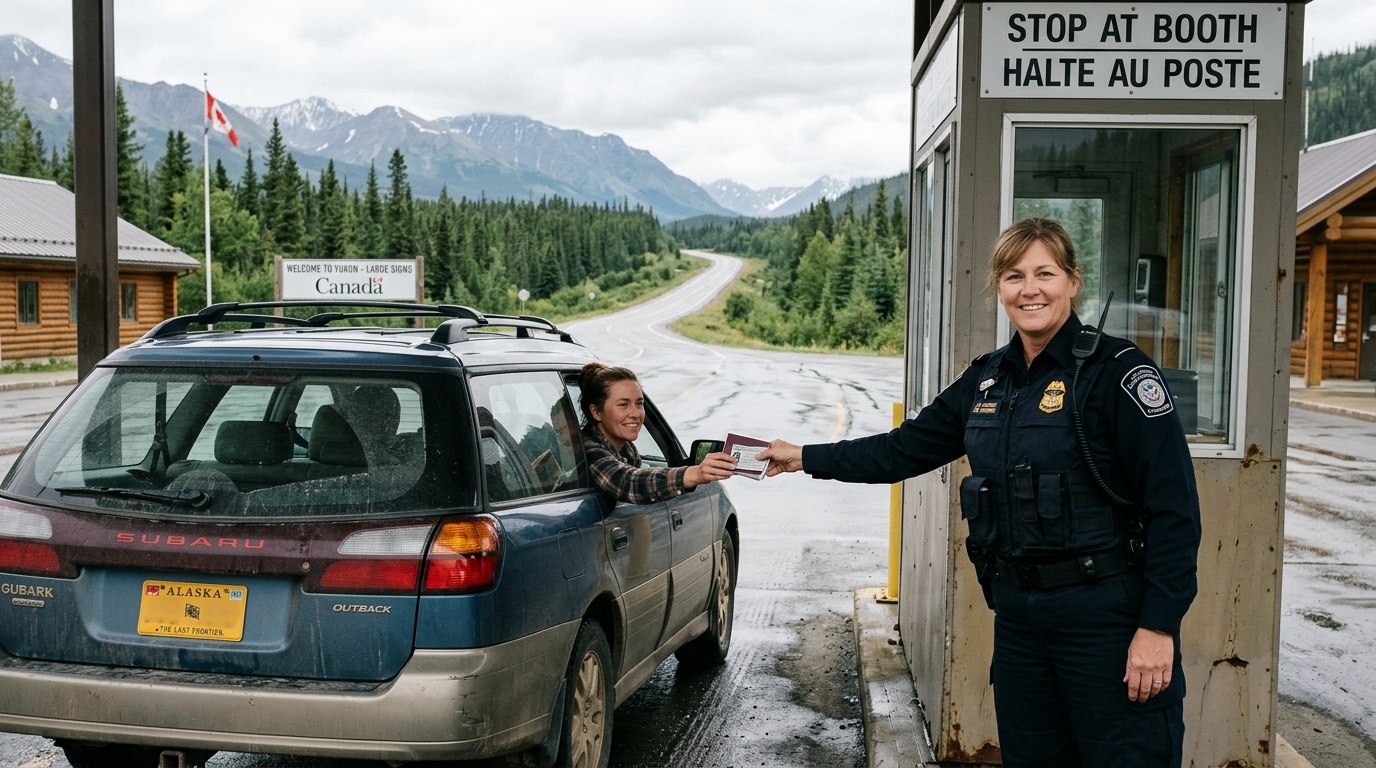
The single biggest operational trap for visitors planning a driving vacation is the standard rental car contract. Travelers often assume that booking an "All-Wheel Drive SUV" or "4x4 Pickup" from national airport chains gives them license to explore gravel roads. It does not.
Standard vehicle rental agreements typically include an unpaved road exclusion clause. These contracts state that operating the vehicle on unpaved, unmaintained, or gravel surfaces constitutes a direct breach of agreement. In Alaska, rental contracts frequently name forbidden routes explicitly, including:
- The Dalton Highway (Route 11) to the Arctic Circle and Prudhoe Bay
- The Denali Highway (Route 8) between Paxson and Cantwell
- The McCarthy Road into Wrangell-St. Elias National Park
- The Taylor Highway and Top of the World Highway to Dawson City
- The Steese Highway beyond Central
Violating this clause triggers immediate financial consequences. The Loss Damage Waiver (LDW) or Supplemental Liability Insurance purchased at the counter is invalidated the moment your tires touch prohibited gravel. If a flying rock shatters the windshield, a sharp shale fragment punctures a tire, or loose gravel causes a slide into a ditch, you become personally responsible for the total vehicle damage.
More critically, towing services on remote routes are extraordinarily expensive. Commercial recovery operations on the Denali Highway or Dalton Highway require dispatching specialized flatbeds from Fairbanks or Palmer. A remote tow costs thousands of dollars, which your credit card coverage or personal auto policy will generally refuse to reimburse if you were driving on a prohibited road.
If your route requires traveling remote gravel highways, rent from independent, Alaska-based specialty vehicle outfitters that explicitly permit unpaved driving in writing. These companies supply properly outfitted vehicles with heavy-duty all-terrain tires, full-size spares, and gravel protection, though their daily rental rates reflect that specialized operational wear. Alaska Road Trip does not book flights or rental cars; you arrange those independently, so confirm the unpaved-road policy directly with your chosen vehicle provider before finalizing your itinerary.
Alaska backcountry driving: what it really takes
Driving Alaska backcountry routes requires deliberate mechanical preparation and self-reliance, even when traveling on state-maintained gravel roads.
Fuel range requires rigorous route planning. On the 135-mile Denali Highway, services are limited to a handful of rustic lodges with seasonal generator-powered pumps that can run dry without notice. On the 414-mile Dalton Highway, the gap between Coldfoot and Deadhorse is 240 miles with zero fuel, food, or medical facilities. Calculate your vehicle's realistic gravel mileage (which drops by 15 to 25 percent compared to paved driving due to rolling resistance and grades) and cross-reference it against our guide to fuel planning and remote gas stations in Alaska.
Standard street tires are inadequate for Alaska gravel roads. Glacial aggregate, crushed basalt, and shale fragments will puncture passenger-car radial tires with ease. Safe backcountry transit demands:
- At least one mounted full-size spare tire matching the diameter of your rolling set (temporary space-saver "donut" spares are useless on shale rock).
- A heavy-duty bottle jack and a flat wooden block to stabilize the jack on soft gravel or mud.
- A 12-volt portable air compressor and a tire plug kit to repair minor tread punctures on the shoulder.
- A two-way satellite messenger (such as a Garmin inReach or ZOLEO) because cellular service drops completely outside primary town limits.
Weather windows in northern latitudes are compressed. Summer road maintenance runs from June through early September. Outside this window, services shut down, seasonal lodges winterize their plumbing, and early snowstorms turn mountain passes into sheets of ice. Heavy summer rainstorms routinely generate washouts along the McCarthy and Denali highways, stranding travelers until state maintenance crews clear debris.
Traffic dynamics on remote routes also differ from standard roads. Industrial haul roads like the Dalton Highway cater primarily to tractor-trailers hauling pipeline equipment. Commercial trucks cannot stop quickly on loose gravel and throw heavy dust clouds that reduce visibility to zero. Give industrial traffic the right of way, pull to the far right shoulder when approaching trucks, and slow down to minimize rock chips thrown at oncoming windshields.
How off-road rules change your itinerary
Deciding whether to incorporate remote gravel driving or off-road exploration shifts how you must build your vacation schedule. It changes vehicle selection, pacing, overnight stops, and contingency margins.
If driving a gravel corridor like the Dalton Highway or McCarthy Road is non-negotiable, your overall itinerary must slow down. While a paved highway allows average speeds of 55 to 65 miles per hour, gravel routes require sustained travel at 25 to 35 miles per hour to avoid tire damage and suspension wear. A 135-mile stretch like the Denali Highway demands six to eight hours of active driving time, excluding photo stops.
For travelers planning their first visit, an honest assessment of tradeoffs often reveals that remote gravel routes add unnecessary stress. Choosing paved corridors allows you to allocate time to the Kenai Peninsula, Seward, and Talkeetna, where paved infrastructure supports exceptional sightseeing, marine wildlife cruises, and accessible hiking without rental contract violations or tire-puncture anxiety.
When you do plan a gravel segment, building an unscheduled buffer day into your route is mandatory. A single mudslide, broken suspension strut, or swollen creek crossing will derail a rigid calendar. If every night's lodging is pre-booked in non-refundable blocks with tight daily mileage requirements, a simple flat tire can cascade into hundreds of dollars in lost hotel reservations.
This structural friction is where do-it-yourself trip planning becomes grueling. Aligning vehicle contract permissions, gravel road open dates, lodge availability, and fuel limits requires balancing moving parts that are invisible until you are already on the road.
Where a planned itinerary fits in
Navigating Alaska's operational realities requires realistic routing built around the vehicle you actually drive. Alaska Road Trip hand-builds custom day-by-day road-trip itineraries that balance drive times, seasonal limitations, and road closures, including the active 2026 Denali Park Road mile 43 closure.
Alaska Road Trip hand-picks lodging and gives you direct booking links, but you book it yourself—it does not make reservations on your behalf, so you keep full control and flexibility. Alaska Road Trip recommends activities and tours with timing and booking links; you reserve them yourself. This ensures you retain full ownership of your bookings while following a verified daily route schedule that avoids gravel-contract traps and unmanageable daily drive times.
Itineraries reflect current-season research at the time they're built. The trip dashboard can check available park, road, weather, and aurora data, but Alaska Road Trip does not provide real-time booking availability, live tracking, or guaranteed live condition monitoring. Every itinerary is hand-built by a named founder who has driven these routes on eight Alaska trips between 2015 and 2024, across four seasons.
The service operates under transparent terms:
- Alaska Road Trip is a one-time flat fee, not a subscription—there are no recurring charges.
- Tier options include Lite for shorter routes, Standard for up to two weeks, Plus for longer journeys, and Concierge, which adds a 30-minute live founder call.
- Every package is delivered as a printable, offline-ready PDF within 3 to 5 business days, including 1 to 2 revision rounds.
- All plans carry a published 14-day money-back guarantee with a full refund, no questions asked.
Bottom line for your 2026 trip
Can you off road in Alaska? Yes, provided you respect land jurisdiction and drive on designated routes. But for a vacation traveler renting a car, the rental contract is the true boundary line. Standard rental vehicles belong on paved pavement, while true off-roading belongs on guided tours or locally rented specialty equipment.
Choose your strategy before booking flights:
- The gravel-highway route: Rent a specialty vehicle from a provider that explicitly authorizes unpaved travel in writing, build dedicated buffer days for mechanical delays, carry two spares, and limit your itinerary scope to accommodate slower speeds.
- The paved route with guided excursions: Rent a standard airport vehicle, stick to Alaska's scenic paved highway grid, and book professional half-day ATV or UTV tours to access the backcountry without contract liability.
Whichever direction you choose, confirm your vehicle permissions, inspect your spare tire before leaving the lot, verify fuel waypoints, and build enough slack into your schedule to adapt to changing northern weather.
Frequently asked questions
Can you off-road in Alaska?
Yes, off-roading is legal on designated public trails, state public-use areas, municipal borough recreation zones, and specific federal lands managed by the Bureau of Land Management. Motorized travel is strictly prohibited on sensitive tundra without snow cover, inside national parks without specialized permits, and across private or Alaska Native corporation lands without explicit permission from the landowner.
Can you off-road in Alaska with a standard rental car?
No. Standard rental agreements from major airport companies strictly prohibit operating vehicles on unpaved roads, dirt tracks, trails, or gravel highways. Driving on these surfaces breaches your contract, automatically voids insurance and loss damage waivers, and leaves you liable for mechanical damage, flat tires, and costly remote towing fees.
What is the difference between off-roading and driving a gravel highway in Alaska?
Off-roading involves navigating unmaintained, natural surfaces such as mud bogs, riverbeds, logging trails, and rock tracks using off-highway vehicles, ATVs, or specially equipped 4x4s. Driving a gravel highway refers to traveling maintained, state-numbered public thoroughfares like the Denali Highway or McCarthy Road. While gravel highways are legal public roads, standard rental car contracts still prohibit driving on them.
Do you need a permit to drive off-road in Alaska?
It depends on the land jurisdiction. Many state public use areas and BLM designated trails require no special permit, provided your ATV or dirt bike is registered. However, entering Alaska Native corporation land requires a purchased land-use permit from that specific corporation, and certain state game refuges or critical habitat areas enforce seasonal permit systems to protect wildlife.
Is the Dalton Highway considered off-roading?
No. The Dalton Highway (Alaska Route 11) is a designated, state-maintained public road built to support the Trans-Alaska Pipeline and Prudhoe Bay oil fields. It is a rough, unpaved industrial corridor composed of gravel, dirt, and chip-seal, built as a road for industrial supply trucks. However, major rental agencies still explicitly ban their standard vehicles from traveling on it.
If you want to skip untangling rental restrictions, gravel-road policies, and fuel gaps on your own, Alaska Road Trip hand-builds a day-by-day itinerary around the vehicle you can actually rent, backed by a flat one-time fee, delivery as an offline-ready PDF in 3 to 5 business days, and a 14-day money-back guarantee. Start with the plan-your-trip page.

See a real Alaska itinerary before you spend a dollar
A real 3-day plan with driving times, lodging picks, and a daylight chart — free, in your inbox.
One email. No spam. Unsubscribe anytime. Or view it right now — no email needed ↗
Ready for the full plan? Get your custom itinerary — from $197 · 5-day delivery →